- About – A little History
- How to visit
- Stay & Dine
- Best Time To Visit
- Top Things To Do & See In Yellowstone National Park
- 1 Day Itinerary
- 2 Days itinerary
- 3 Days Itinerary
About – A little History
Yellowstone became the first national park for all to enjoy the unique hydrothermal and geologic features on March 1, 1872. Within Yellowstone’s 2.2 million acres, visitors have unparalleled opportunities to observe wildlife in an intact ecosystem, explore geothermal areas that contain about half the world’s active geysers, and view geologic wonders like the Grand Canyon of the Yellowstone River.
Located in the western United States, largely in the northwest corner of Wyoming and extending into Montana and Idaho. Yellowstone is also the first national park in the world. The park is most popular for its wildlife, and its many geothermal features aka Geysers with Old Faith Geyser being one of its most popular geyser.
Native Americans have lived in the Yellowstone region for at least 11,000 years aside from the visits by mountain men during early-to-mid-19th century. National Park Service took over the administration of the park in the year 1917. Hundreds of structures were built and protected for their architecturual and historial significance. Yellowstone National Park spans of an area of 3468.4 sql miles comprising lakes, canyons, rivers and mountain ranges. Yellowstone lake is one of the largest high-elebation lakes in North America and is centered over the Yellowstone Caldera, the largest super volcano on the continent. Yellowstone has numerous recreational opportunities including hiking, camping, boating, fishing and sightseeing. During winter, visitors often access the park by way of guided tours that use either snow coaches or snowmobiles.
How to go to YNP
By Car: The best way to go to Yellowstone National park is by flying to the nearest airport and then renting a car. There are regional airports located near the park. But flying to the regional airports can sometimes be expensive as there are not much domestic flight connectivity.
We flew to Bozeman Montana airport and stayed at nearest accommodation closer to the airport and then drove next day morning from there to the park. Commercial airlines serve the following airports near Yellowstone National Park all year: Cody and Jackson WY, Bozeman MT, Idaho Falls ID. The West Yellowstone MT airport is serviced from early May to mid-october from Salt Lake City, UT.
By Bus: Bus service is available from Bozeman, MT to West Yellowstone MT via Highway 191 and is available all year. Bus service directly from Idaho to West Yellowstone is limited to the summer months. Commercial transportation from Bozeman, MT to Gardiner, MT is available during the winter and summer seasons. Commercial transportation to the park from Cody and Jackson, WY is available during the summer season.
Note: There are no train stations available to the park. Nearest train depots are in southeast idaho, Salt Lake City, Utah and northern Montana.
Important: Although you do not need to have vehicle reservations to enter the park, you will still need park pass to enter the park which is about 35$ per vehicle. You can buy Beautiful America Annual Park Pass which gives you entry to not just Yellowstone but to any other national parks in the country which in our opinion is 100% worth it.
Tips for visiting YNP
- Always book in advance and try booking shoulder months where you can expect less crowds.
- Although it can be hard to stick to your Itinerary due to weather conditions or traffic etc. it is still important to have a travel plan and make sure you always consider traffic when you plan.
- Learn about Geyser eruption times on the NPS website and plan your travel accordingly. You don’t want to be there too early and wait longer for geyser eruption.
- The weather can be very unpredictable, always be prepared. Have rain coats and have extra pair of clothing.
- Always respect wildlife. Do not try to get too close to bears/bisons. Especially bears when they are around cubs and always carry bear spray with you. Do not try to run when you see a bear. Slowly back away and give bear and its cub plenty of space.
- Be prepared for the traffic especially during peak times and plan accordingly.
- Parking spaces can fill very quickly. So start your day early.
- Follow speed limits. Sometimes bears and other wildlife will be crossing the road and majority of the wildlife deaths are due to people’s negligence.
- Go hiking. The best way to enjoy the beauty of Yellowstone is by walk. Remember to check out popular hiking places in the park and plan.
- Bring Binoculars and Good Camera. We bought our binoculars on Amazon. They are not too expensive you can get one for a decent price. Observing wildlife is a popular attraction and you will definitely need binoculars.
- Yellowstone is open year-round. Depending on what activities you want to do, you can decide the best time to visit. We usually prefer summer since the wildlife are mostly active in Summer.
- Try to pay your entrance fees in advance. The entrance for the private vehicle is 35$. You can also get America the Beautiful annual pass at any national park entrances and they are 80$ per pass. Its definitely worth It!!
Restaurants we dined & Hotels we stayed
Although there are plenty of hotels to stay near the park, during peak times they are very expensive and they get booked more than a year in advance. So plan accordingly.
We looked for budget options to stay near the park (It is very costly to find one inside the park). Depending on the where we will be at the end of day, we look for budget options nearby.
Whenever we go out of California, we usually prefer Indian, or Mexican or Thai food. For breakfast, its mostly scrambled eggs/french toasts and for Lunch/Dinner its either a sandwich or we will go to an Indian restaurant if they are nearby.
Since dining options are minimum once you are in the park, to make our travel easier, we took ready to eats which we could prepare instantly and we had those for our lunch and dinner.
Airbnb @Belgrade Montana: On the first night we landed at Bozeman International Airport, we did Airbnb close to the airport. We stayed at a cozy two bedroom apartment which was newly renovated and was kept so clean and the host was super amazing and made sure we had everything we needed for our stay. We honestly felt we should have stayed little longer, but unfortunately due to time constraints, we couldn’t (Thanks Garrett for hosting and for such an amazing place). We had our morning breakfast with cereals, scrambled eggs and some hot tea which we made.
For more details on the Airbnb, view his listing here.
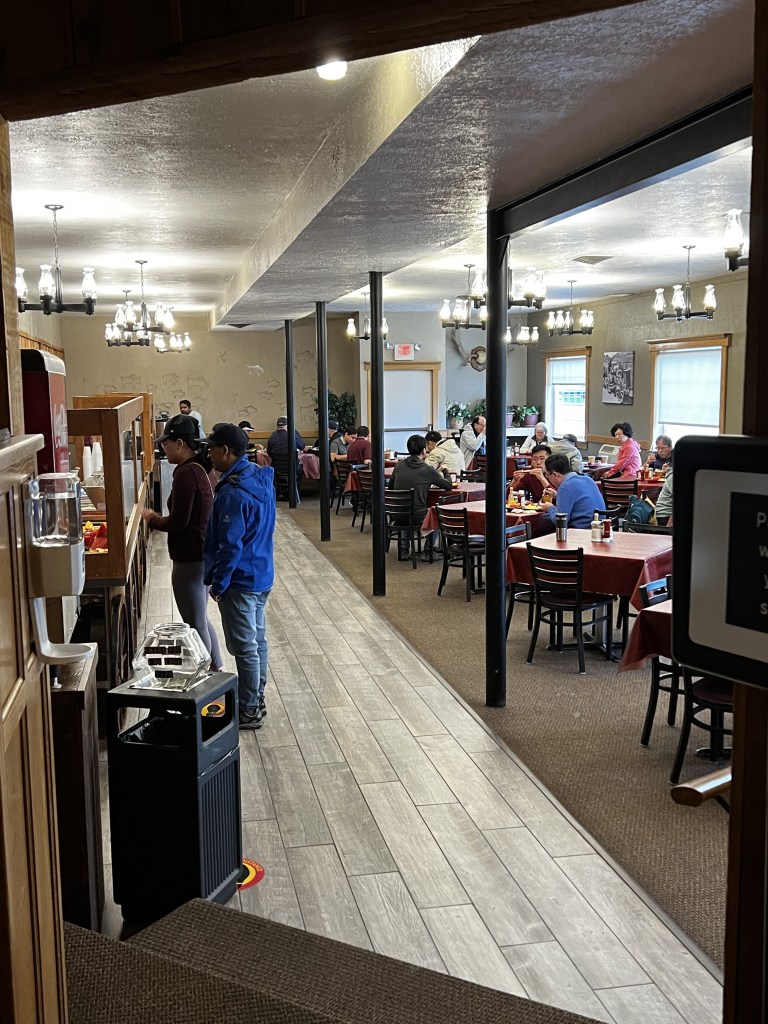
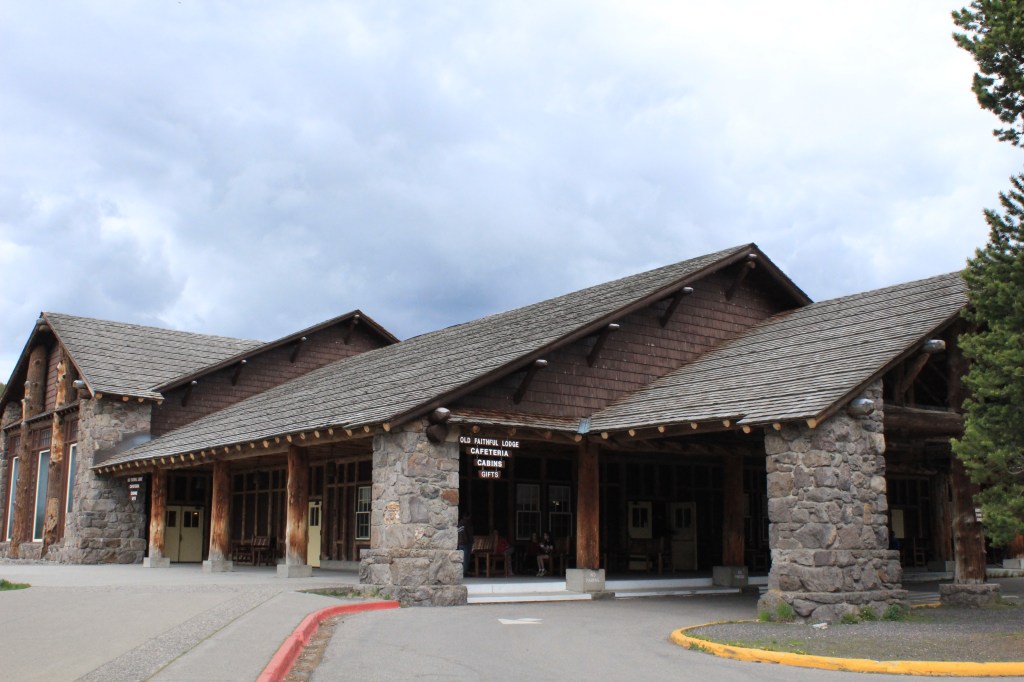
Old Faithful Inn: Well although its a popular tourist attraction in the park, if you are looking for vegetarian options, this is not the place for you. We went here for lunch and they had a buffet option, but they ran out of food and we were asked to wait till they made it fresh. My wife is a vegetarian, and she could only eat corn, mac n cheese and some black beans and bread. On top of that, they made us wait for at least an hour before we could get food and the people who served where so slow and they actually didn’t bother to check if the food was ready when they could clearly see people are waiting for the food.
We do not recommend eating here!!
Physical Address: 3200 Old Faithful Inn Rd, Yellowstone National Park, WY 82190
Phone: (307) 344-7311
White Buffalo Hotel: This hotel is on the west side of Yellowstone and offers a full, hot breakfast, large, clean rooms and a private courtyard. It is also one of the budget hotels in the park. The hotel staff were friendly and we had a good hot breakfast with fruits, french toast, scrambled eggs, fruits, cereals, oatmeals and coffee. They will serve you the breakfast individually which kinda makes sense, because that way the food doesn’t get wasted.
We stayed here for two nights and we definitely recommend this place. Its Cheaper and has good breakfast options.
Physical Address: 236 Dunraven St, West Yellowstone, MT 59758
Phone: (406) 646-7681



Airports Near Yellowstone National Park
Yellowstone Airport (WYS) is a seasonal airport and is about 1 mile from downtown West Yellowstone, Montana. This airport is open from June to September. Delta Airlines and its partner airlines SkyWest operates flights from Salt Lake City (SLC).
3 miles from the west entrance of the park.
Jackson Hole Airport (JAC): located near Jackson, WY. This airport is open year-round and serviced by Delta, American Airlines and United.
71 miles from the South Entrance and takes about 1 hr to drive to the park.
Salt Lake City International Airport (SLC): Located in Salt Lake City, UT and its open year-round. Serviced by Delta Airlines, JetBlue, Frontier, American Airlines, Southwest, KLM and United Airlines. This airport is considered to have great domestic flight connectivity. However the only con to is the distance to the park.
386 miles to the West Entrance. Takes about 8hrs to drive to the park.
Bozeman International Airport (BZN): Located in Bozeman, MT, this airport is also open year-round and is the busiest airport in Montana. Serviced by Delta, American Airlines, United, Frontier, Allegiant, and Alaska Airlines. JetBlue also offers flights to the park but only during summer.
91 miles from the North Entrance and takes about 2 hours to drive to the park. (Well!! thats not bad)
Note: Since we flew to Bozeman International Airport, we started from the north entrance and then covered the south side of the park including the neighbor park, Grand Teton National Park which has a separate travel guide. However we did cover both the parks in the same visit.
Driving To Yellowstone National Park
Yellowstone National Park (YNP) has 5 entrances:
- North Entrance – Gardiner, Montana – U.S. 89 (We drove from here)
- Northeast Entrance – Cooke City, Montana – U.S. 212
- South Entrance – Jackson, Wyoming – U.S. 191
- West Entrance – West Yellowstone, Montana – U.S. 20 and U.S. 191
- East Entrance – Cody, Wyoming – U.S. 20
Only the north entrance. is open year-round. All other entrances are closed to vehicle traffic. West and South Entrances are closed to traffic but is open only for the guided tours. South and East entrances offer guided snowmobile tours.
Important: Weather in Yellowstone can be unpredictable and can change quickly especially during the winter. Please make sure to check current conditions and closures on the NPS website before making any travel plans.
Best Time To Go
The best months to visit Yellowstone are April to May and September through early October. These are also considered as off season months and you can have great chances of catching a glimpse of local wildlife and enjoy with thinner crowds.
April end, May, June, July and August are considered to be peak months as they draw hundreds of thousands of visitors to the park. During these months, you will have to plan your travel well in advance as the hotel accommodations and flights are at their peak rates and you can expect more traffic and higher wait times in the park during these months.
How many days do you need
It is said that even if you spend an entire summer in the park, you will still not be able to cover all the places due to its vast area and more than 900 miles of hiking trails. You can explore some of the popular attractions in the park in two days but having 3 days will give you more time to do that without having to rush. We have made our Itinerary below for 1, 2 or 3 days.
We felt having 3 days should be sufficient enough in the park to cover major top attractions.
Note: We had travelled during the month of June and we still observed light drizzle during the day a couple of times while we were there. We feel July end or August will be the best time to visit the park.
Visitor Centers
There a total of 10 visitor centers in the park.
- Albright Visitor Center: Located at the mammoth hot springs area, five miles south of. the North Entrance at the northern part of the upper loop of Grand Loop Road. This will be your first visitor center if you are coming from the norht entrance. Open daily 9 to 5PM except for holidays. For details visit https://www.nps.gov/yell/planyourvisit/albright-visitor-center.htm.
- Canyon Visitor Education Center: Explore this visitor center near Canyon Village area in the park. Open Daily: 8 – 6 PM. This visitor center located in the Canyon Village complex near the center of the Grand Loop Road system. More details, visit https://www.nps.gov/yell/planyourvisit/canyonvc.htm.
- Fishing Bridge Visitor Center: Located one mile off the Grand Loop Road on the East Entrance Road. Located near the north shore of Yellowstone Lake on the East Entrance Road. Open daily 8AM-6PM. More details, visit https://www.nps.gov/yell/planyourvisit/fishing-bridge-visitor-center.htm
- Grant Visitor Center: located on the western shore of Yellowstone Lake, a short distance south of the West Thumb Geyser Basin. Open Daily 8AM – 6PM. For more details, visit https://www.nps.gov/yell/planyourvisit/grant-visitor-center.htm
- Madison Information Station: Located about halfway between Old Faithful and West Yellowstone, you can stop here for park information, shop for souvenirs in the park store, attend a ranger program, or use the restrooms. Open daily 9AM – 4.30 PM. More details, visit https://www.nps.gov/yell/planyourvisit/madison-information-station.htm
- Museum of the National Park Ranger: Located off the Grand Loop Road at the entrance to Norris Campground. Please visit, the website for more details: https://www.nps.gov/yell/planyourvisit/museum-of-the-national-park-ranger.htm
- Norris Geyser Basin Museum: Situated on the ridge overlooking the Norris Geyser Basin, this historic building is staffed during the summer with rangers who provide park information and facilitate ranger programs. Restrooms are located in the parking lot. This visitor center is located 1/4-mile west of Norris Junction just off the Grand Loop Road. For mode details, https://www.nps.gov/yell/planyourvisit/norris-geyser-basin-museum.htm.
- Old Faithful Visitor Center: Located near one of the most popular geyser in the park, Old Faithful, this visitor center offers views of the geyser eruption from the tall, windowed front of the visitor center. You can also check the geyser eruption times. You can get park information, maps, passport cards/stamps, shop for souvenirs in the park store, or use the restrooms. Open daily 8AM – 6PM. For mode details, visit the NP website https://www.nps.gov/yell/planyourvisit/oldfaithfulvec.htm
- West Thumb Information Station: This is a small facility at the start of the West Thumb Geyser Basin boardwalks, where you can visit with a park ranger and gather park information, shop for souvenirs in the park store, and join a ranger program. Open daily 9AM – 5PM. Visit https://www.nps.gov/yell/planyourvisit/west-thumb-information-station.htm
- West Yellowstone Visitor Info Center: Located in the west yellowstone area, this visitor center is open year-round and staffed by the West Yellowstone Chamber of Commerce. Also open daily 8AM – 6PM. Visit https://www.nps.gov/yell/planyourvisit/west-yellowstone-visitor-information-center.htm for mode details.
Top Attractions In The Park
- Visit the Roosevelt Arch at the north entrance
- Mammoth Hot Springs
- Lamar Valley
- Tower Falls
- Grand Canyon Of the Yellowstone Upper Falls & Lower Falls
- Artist Point
- Hayden Valley
- Visit the Geysers
- Old Faithful Inn
- Mystic Falls
- Lewis lake and Falls
- Yellowstone Lake
- Moose Falls
- Viewing Wildlife (popular spots to see them, what not to do and what to do when you see a bear).
- Go Hiking
Roosevelt Arch at the north entrance
Located near the north entrance of the Yellowstone National Park, Roosevelt Arch is a rusticated triumphal arch in Gardiner, Montana. It was constructed under the supervision of US Army at Fort Yellowstone and its cornerstone was laid out by President Theodore Roosevelt in 1903. The top of the arch is inscribed with a quote from the Organic Act of 1872, and reads: “For the Benefit and Enjoyment of the People”. In 1903, when the railway finally came to Gardiner and with the development of the Gardiner train station, the arch was proposed as part of the station ensemble. You can see this beautiful 50 foot tall arch from miles away.
To learn more about the arch, you can watch a short video on the NPS website https://www.nps.gov/yell/learn/photosmultimedia/0002rooseveltarch.htm
Physical address: 2819 US-89, Gardiner, MT 59030 and it’s about 88 miles from Bozeman International Airport, MT and takes about 1.3 hrs to drive.
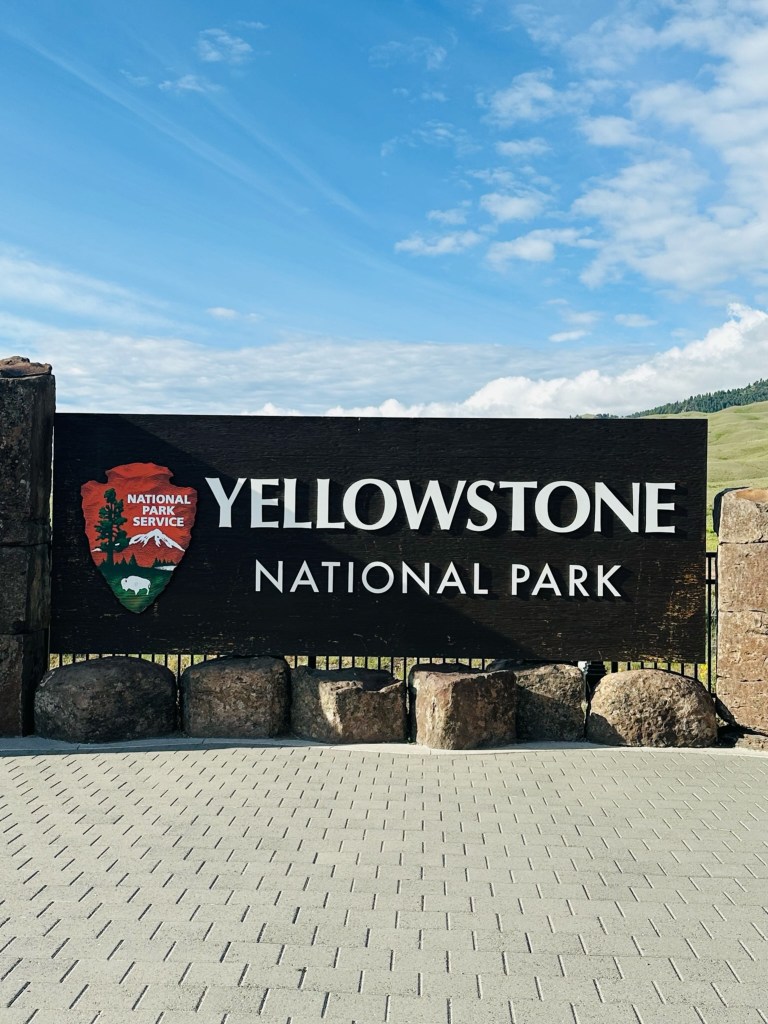
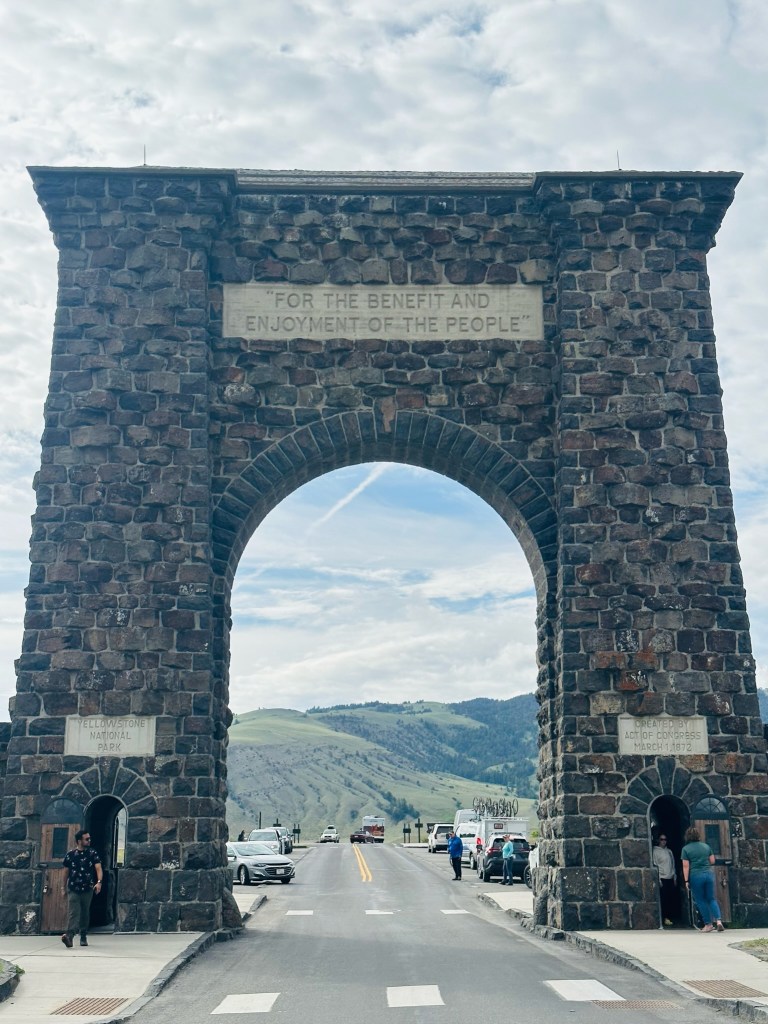
(Left to Right: YNP sign at the North Entrance and Roosevelt Arch)
Mammoth Hot Springs
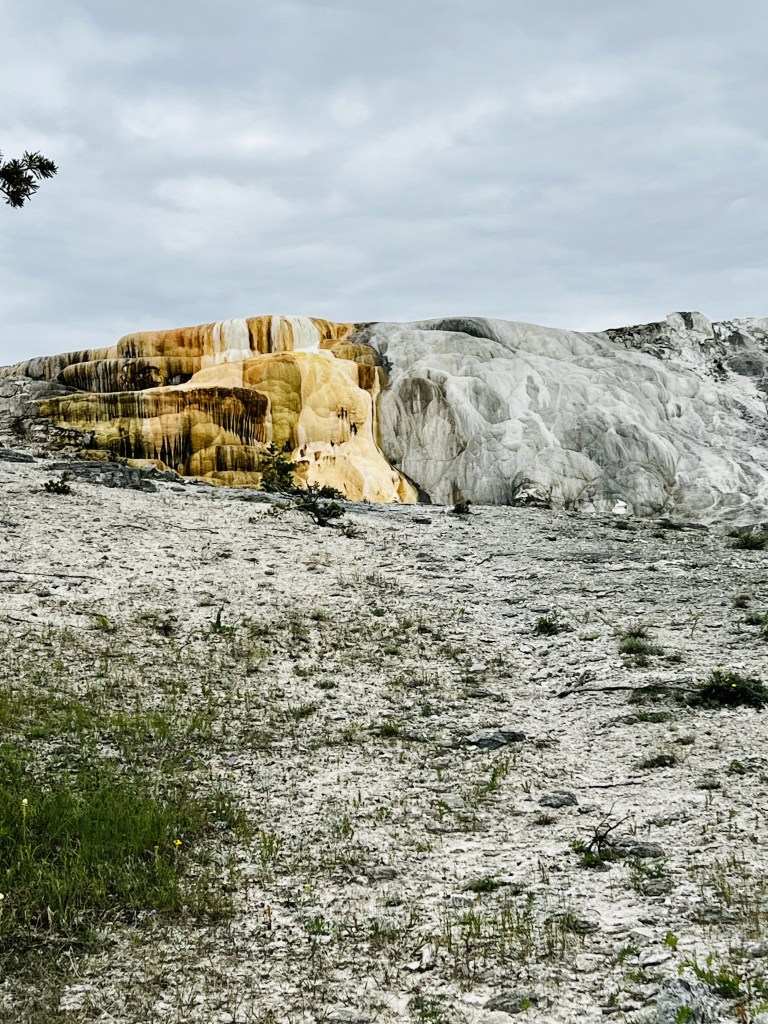
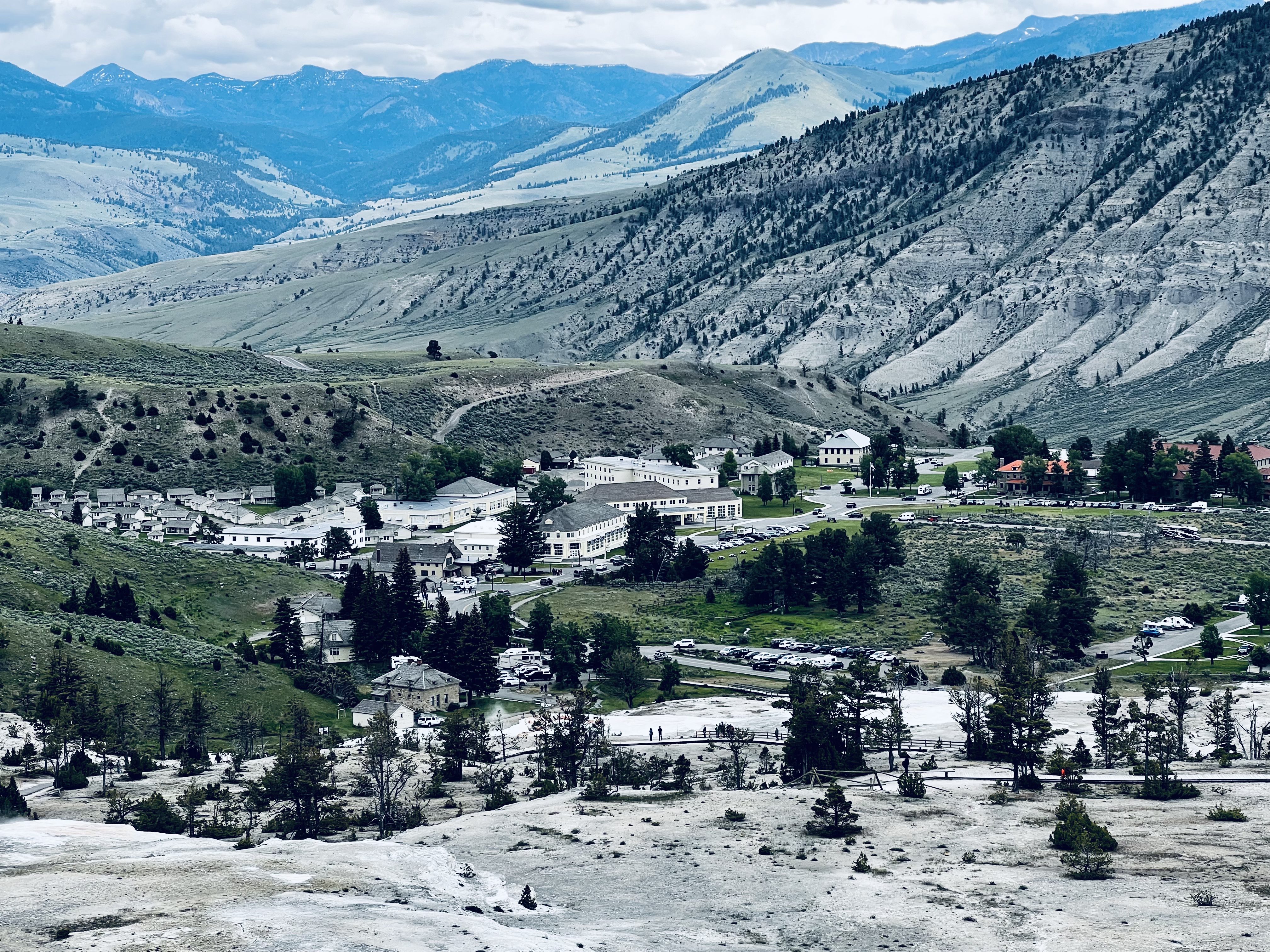
Mammoth hot springs are must see attraction in Yellowstone National Park. These are large complex hot springs in YNP adjacent to Fort Yellowstone and the Mammoth Hot Springs Historic District.
Every year, rain and melted snows seeps into the earth in Yellowstone. Even though the water was cold initially, they are quickly warmed by heat radiating from a partially molten magma chamber deep underground. These hot water no rise up through a system of small fissures and they interact with hot gases charged with carbon dioxide rising up from the magma chamber. A weak carbonic acid solution is formed since some of the carbon dioxide is dissolved in the hot water.
When the hot acidic solutions dissolves large quantities of limestone (which are a soft type of rocks responsible for these formations) through. the rock layers to the hot springs on the surface. When exposed to air, some of the carbon dioxide escape from this solution and when this happen, limestone will not able to remain in the solution and thus forming a solid material. This white chalky mineral which gets deposited at the top, forms these amazing terraces.
There are approximately 50 hot springs within the Mammoth Hot Springs area. There are two terrace boardwalks, the upper and lower. Lower Terrace boardwalk is accessible from the parking lot or the Grand Loop Road. Upper terrace can be accessed from the Upper boardwalk from the one-way Upper Terrace Drive and parking lot.
How to visit: Boardwalks for both Upper and Lower terraces cover about 1.75 miles. Its relatively easy hike and takes about an hour to finish.


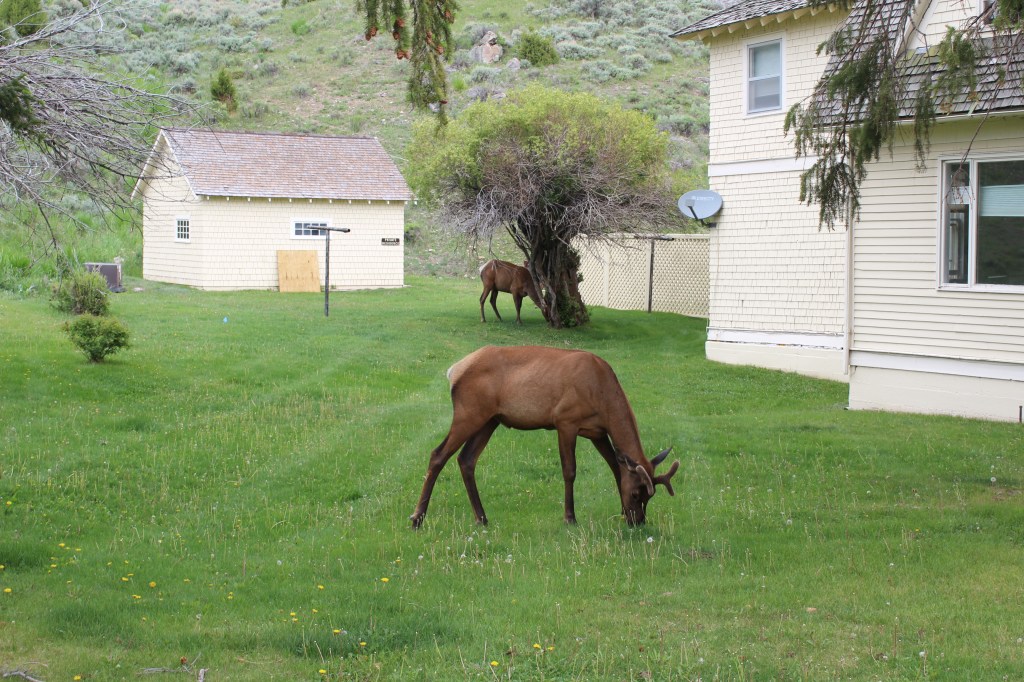
Elks grazing near Mammoth
Lamar Valley
Viewing wildlife is a popular attraction in Yellowstone National Park and Lamar Valley is one of the best place to view wildlife. You will have best chance of spotting bears, wolves, bison, pronghorn, and many more species in Lamar Valley.
Where is it: Located in the northeastern corner of the park, the Lamar Valley, along the Lamar River, often called America’s Serengeti for its easy-to-see populations of large animals.
Quick Tip: If you want to view wild animals, the best time is dawn or dusk.
Getting there: You can reach Lamar Valley from Mammoth Hot Springs by taking Grand Loop Road east past the Roosevelt Arch, and then continuing on the northeast entrance road.
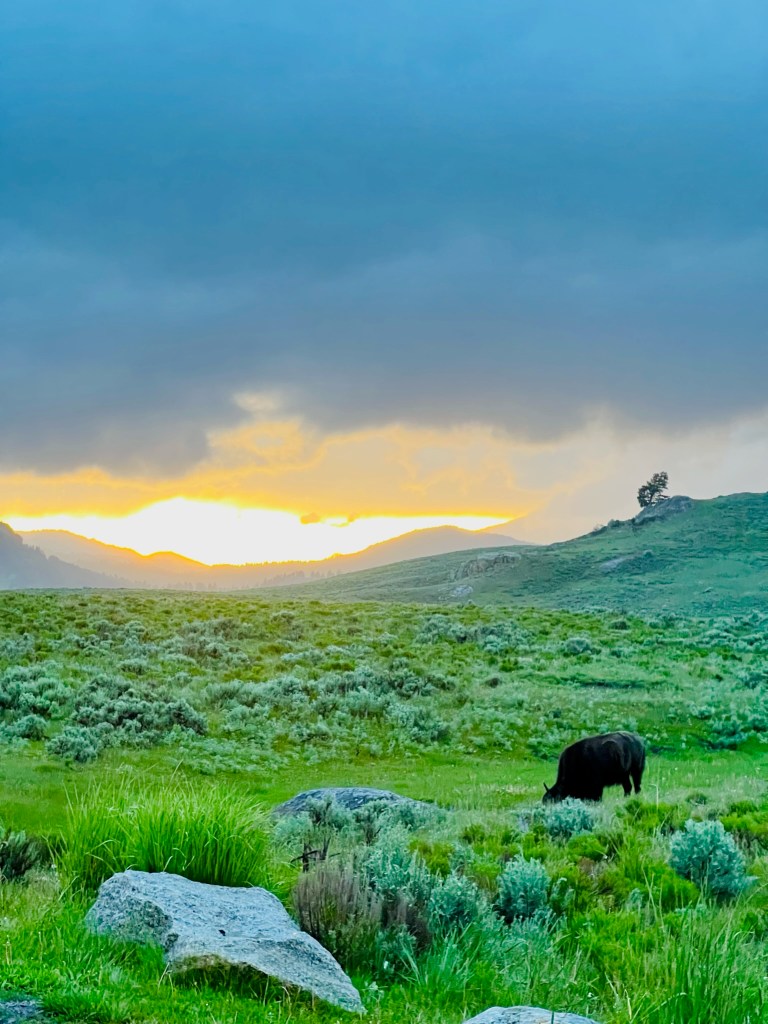
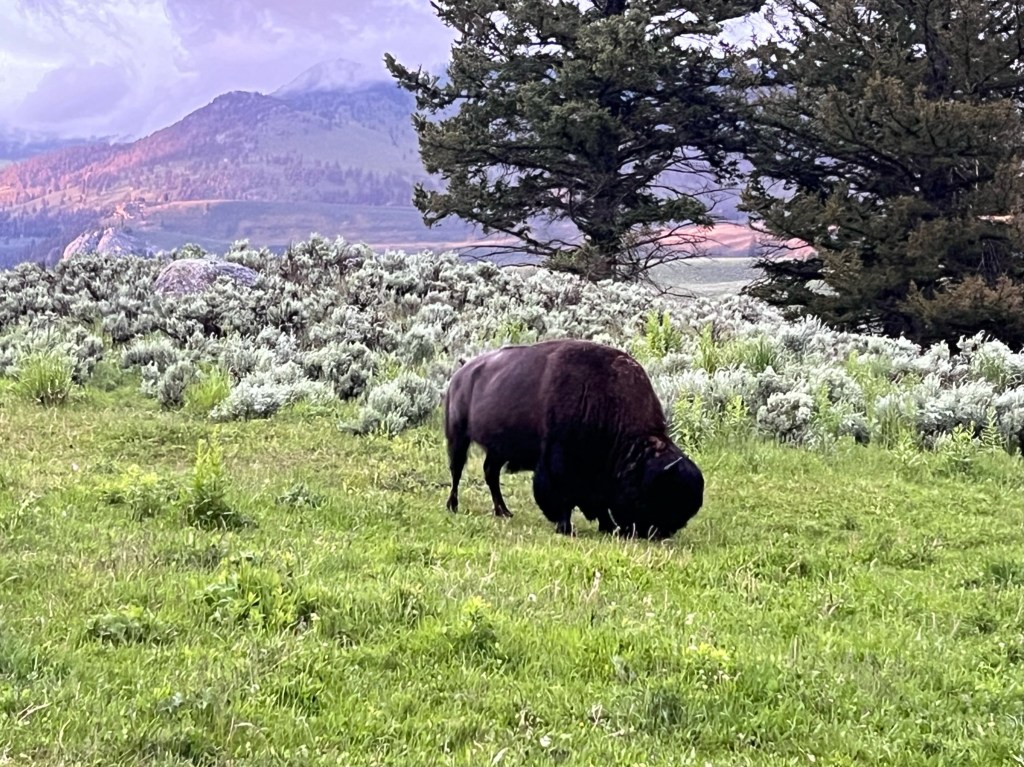
Bisons Grazing near Lamar Valley Area
Tower Falls
Total Hike: 0.9 miles Round Trip (Time needed: Approximately 35 mins)
Level of difficulty: Easy
About: Tower falls is a waterfall on Tower Creek in the northeastern region of Yellowstone National Park, in the U.S. state of Wyoming. The fall plunges from a height of 132 feet (40 m) and get its name because of the towers of stone that surrounds the top of the falls.
How to get here: You can see the falls by driving 2.2 miles south of Tower-Roosevelt Junction between Tower-Roosevelt Junction and Canyon Village. The viewpoint to the falls is just about 100 yards from the parking area.

Tower Falls
Grand Canyon Of the Yellowstone
YNP has it own Grand Canyon. Grand Canyon of the Yellowstone is one of absolute best places to see in YNP. This is about 20 miles long and between 800 – 1200 ft deep. It is also the same canyon through which Yellowstone river flows as it plunges over the lower Yellowstone Falls.
There are many outlooks offering the Grand Canyon view. There are views from both the North and the South rim with several miles of hiking trails which connects these viewpoints. Both the north and south rim trails are accessible by car.
Hike Distance: North rim drive is one way route which takes you to the Brink of lower falls lookout point. North rim begins 1.2 miles (1.9 km) south of Canyon Junction and you can view Lower Falls from Lookout, and see it again from a distance at Inspiration Point.
The road to the brink of Upper Falls is 1.6 miles (2.6 km) south of Canyon Junction on the Grand Loop Road. If you follow the paved path, you can reach a great vantage point for viewing the Yellowstone River as it plunges over the Upper falls.
The South Rim drives begins about 2.3 miles south of Canyon junction and this drive also leads to the views of Upper Falls from its viewpoints and the drive ends near the Artist Point.
Quick Note: This is a popular area in the park and parking near the trails can fill up very quickly. So plan to be here early in the morning. To get better view, try visiting South Rim in the morning and North rim in the evening.
For more information on the history and details on the Grand Canyon of Yellowstone, visit the NPS website. You can also refer to the below NPS map for more details as well.
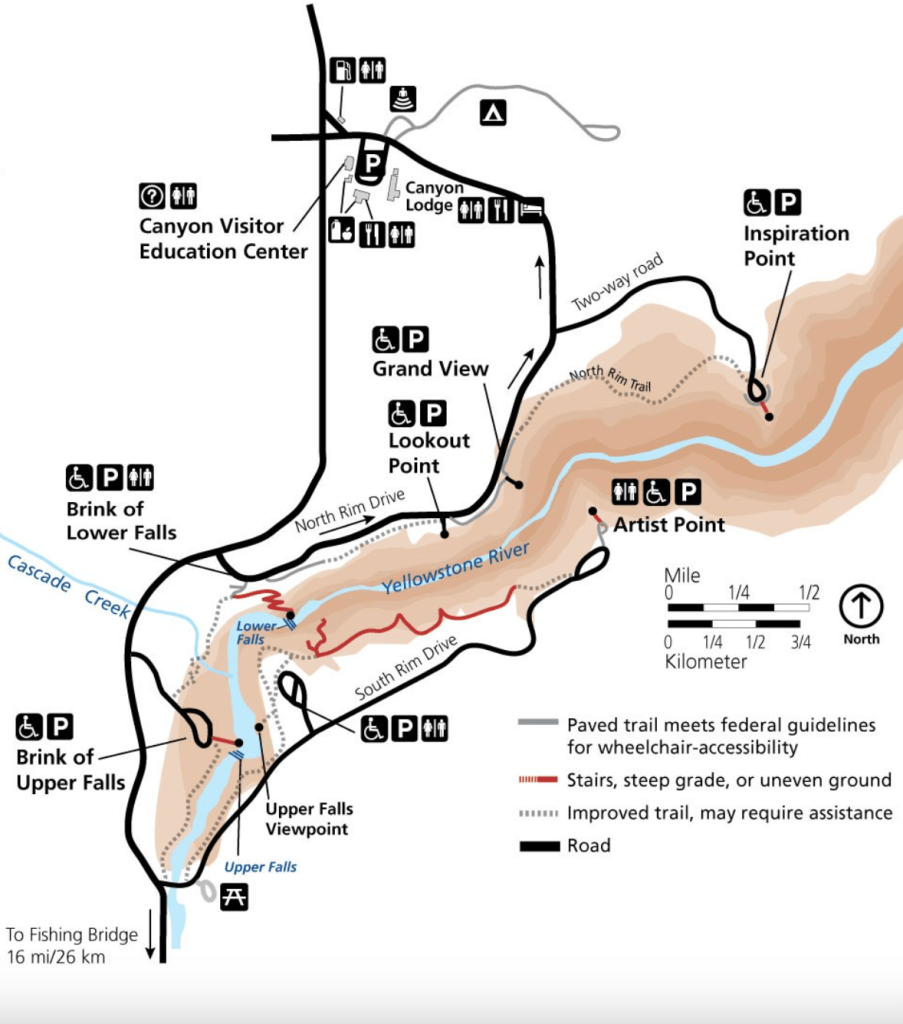
Grand Canyon Of Yellowstone Map (Photo: NPS)
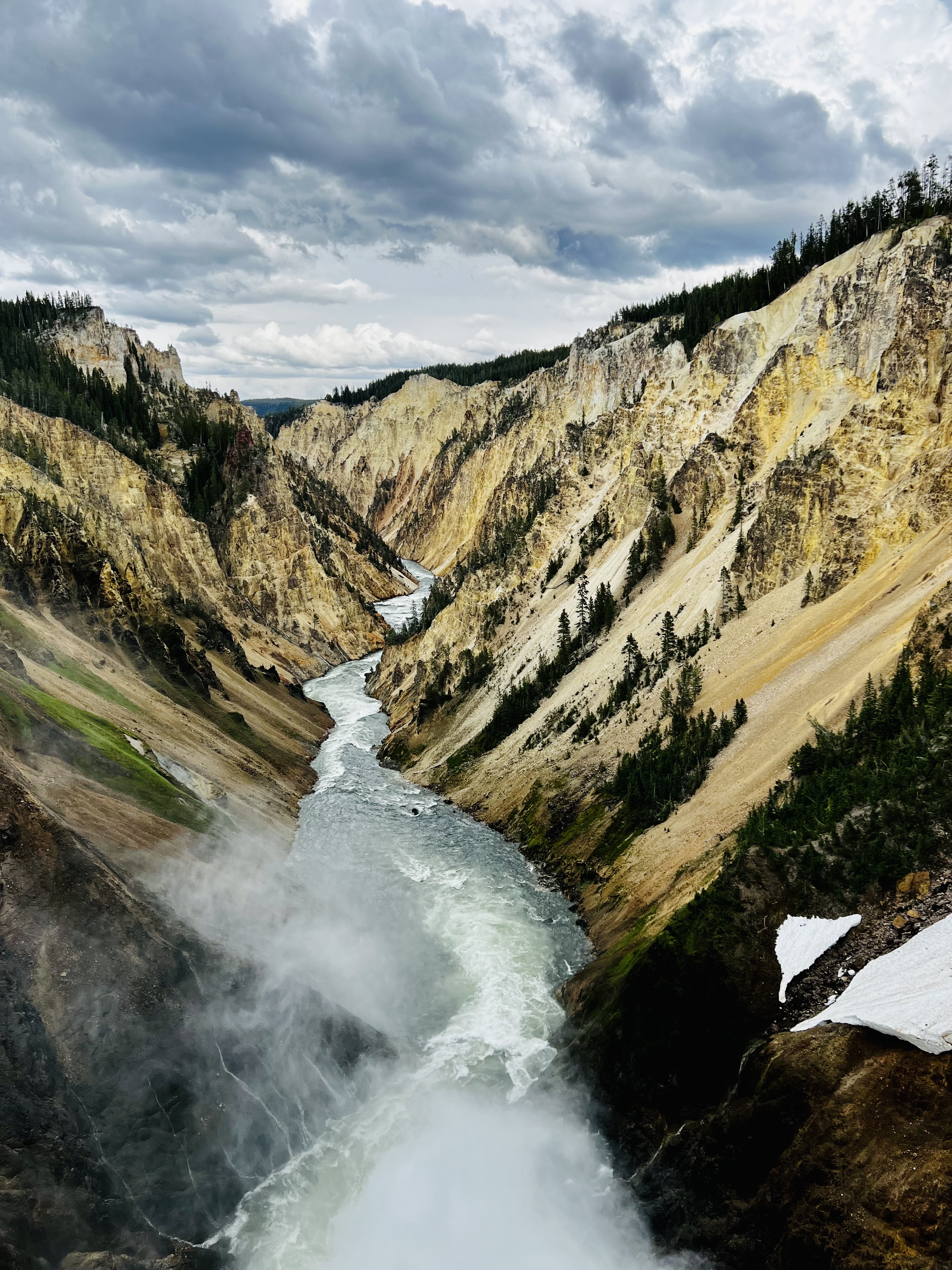
Grand Canyon of the Yellowstone
Artist Point
Artist Point is in the Grand Canyon area of Yellowstone and at the end of the South Rim drive. Its a fantastic location to see the Canyon and the lower falls. Its a short 0.2 mile out and back trail from the south rim drive and takes about 10 mins to complete.
How to get to the trailhead: From Canyon Junction, where Norris Canyon Road and Grand Loop Road meet, drive 2.2 miles south and turn left onto South Rim Drive. Proceed another 1.6 miles to the parking area at the end of the road. From here it should be a very short walk to the beautiful artist point.

Grand Canyon Of the Yellowstone View from Artist Point
Hayden Valley
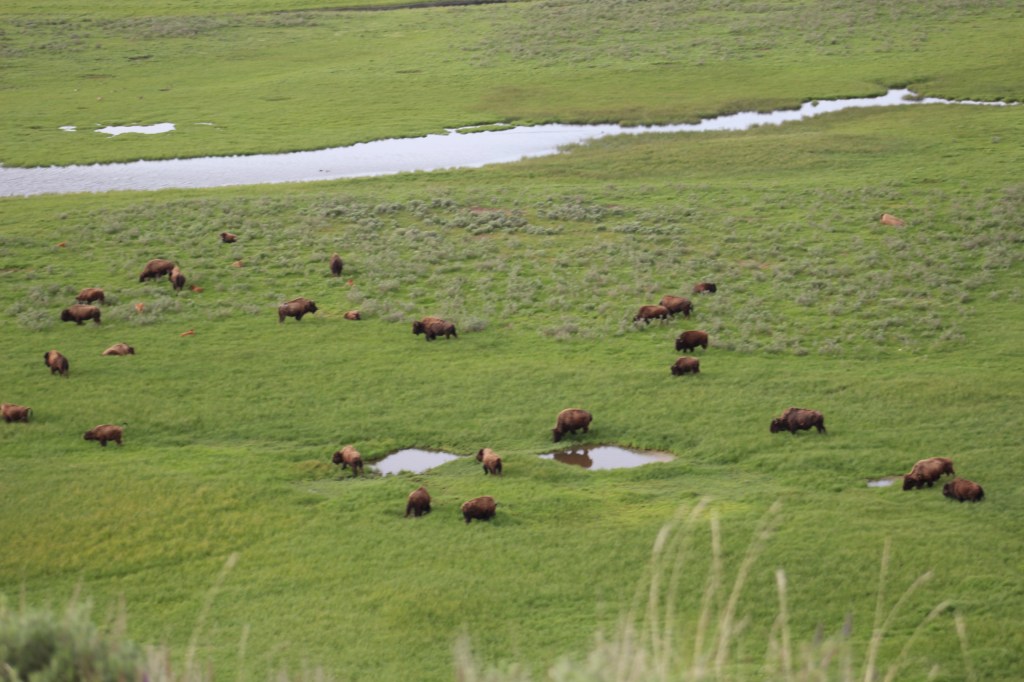
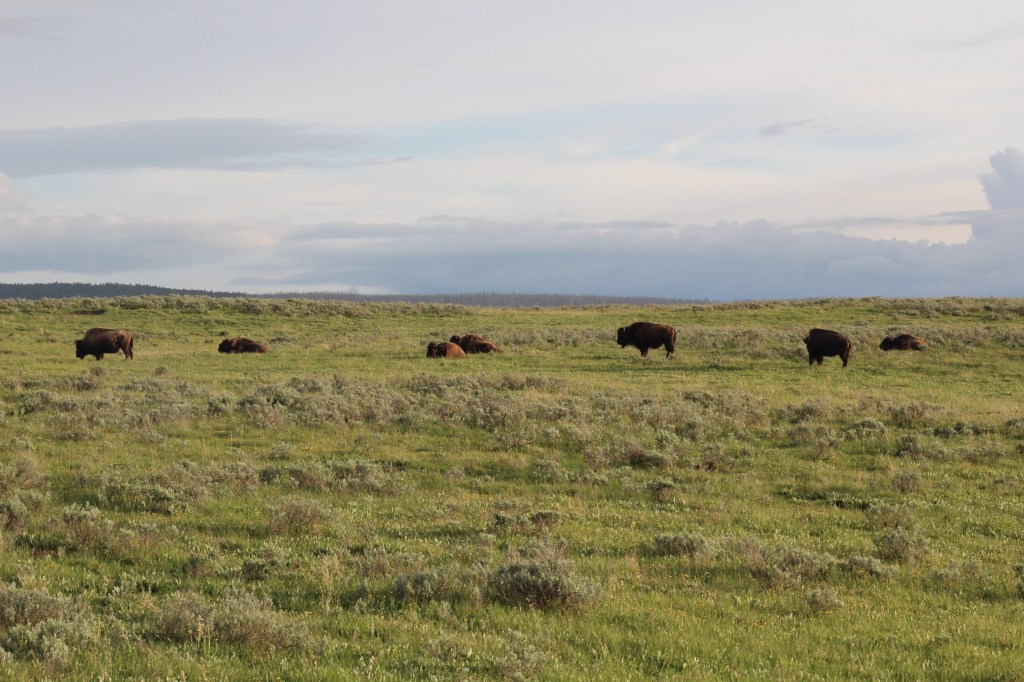
Hayden Valley is another great location to see wildlife. Although we could not see any other animals except Bison (Honestly at some point we got bored of seeing Bisons. lol!!). This is still a good place to see wildlife especially if you come early morning or in the evenings.
Unfortunately, on the first day it was bit drizzling when we went and we could only see Bisons near the grand loop road near Hayden Valley and Lamar Valley.
How to get here: The drive to Hayden Valley from the Canyon Village Visitor center takes about 15 – 16 mins (8.7 miles approx.) assuming there is no traffic. It’s common for people to just pull to the side of the road and get out to see nearby wildlife and this is also your sign to pull over to see the wildlife.


Bisons near the Grand Loop Road near Hayden Valley
Visit the Geysers
Yellowstone National Park preserves the most extraordinary collection of hot springs, geysers, mud pots, and fumaroles on Earth. More than 10,000 hydrothermal features are found here, of which more than 500 are geysers.
Geysers are hot springs with constrictions in their plumbing, usually near the surface, that prevent water from circulating freely to the surface where heat would escape. The deepest circulating water of the system can exceed the surface boiling point of water (199°F/93°C). Surrounding pressure increases with depth, much as it does with depth in the ocean. Increased pressure exerted by the enormous weight of the overlying water and rock prevents the water from boiling. As the water rises due to heating, steam forms and expands, increasing pressure in the constricuted plumbing near the surface. At a critical point, the confined bubbles actually lift the water above the surface vent, causing the geyser to splash or overflow. This decreases pressure on the system, and violent boiling results. Tremendous amounts of steam force water out of the vent, and an eruption begins. Water is expelled faster than it can enter back into the geyser’s plumbing system, and the heat and pressure gradually decrease. The eruption stops when the water reservoir is depleted or when the system cools. (Source NPS).
There are more geysers in Yellowstone than anywhere else on Earth. Old Faithful, certainly the most famous geyser, is joined by numerous others big and small, named and unnamed. Though born of the same water and rock, what is enchanting is how differently they play in the sky.
In this blog, we are going to list the top Geysers you must visit while you are in Yellowstone. We recommend that you balance between the scenic spots, hikes and geysers and we also recommend to visit only the popular geysers in the park because at some point you will definitely feel like its too much of just the Geysers plus spending too much time near geysers is not good for health.
- OLD FAITHFUL GEYSER & THE UPPER GEYSER BASIN
Old Faithful Geyser is the famous Geyser in the park. Watching Old Faithful Geyser erupt is a Yellowstone National Park tradition. People from all over the world have journeyed here to watch this famous geyser. It was the unique thermal features like Old Faithful Geyser that inspired the establishment of Yellowstone as the world’s first national park in 1872.
Old Faithful is one of nearly 500 geysers in Yellowstone and one of six that park rangers currently predict. It is uncommon to be able to predict geyser eruptions with regularity and Old Faithful has lived up to its name, only lengthening the time between eruptions by about 30 minutes in the last 30 years. Thermal features change constantly and it is possible that Old Faithful may stop erupting someday. Geysers and other thermal features are evidence of ongoing volcanic activity beneath the surface and change is part of this natural system. Yellowstone preserves the natural geologic processes so that visitors may continue to enjoy this natural system.
Time needed here: We recommend an hour and a half at least to give yourself plenty of time, to park, get information and maps from the visitor center, watch the Geyser eruption and to visit the famous Old Faithful Inn.
How to watch the Geyser eruption: As this is right next to the famous Old Faithful Inn you can watch eruptions from the Old Faithful viewing area or along the boardwalks that weave around the geyser and through the Upper Geyser Basin.
Old Faithful erupts every 35 to 120 minutes for 1 1/2 to 5 minutes. You can get all the updated eruption times from the NPS website and also from the NPS app directly. https://www.nps.gov/yell/planyourvisit/geyser-activity.htm


From left to right: Old Faithful Geyser sign, geyser eruption and the eruption times displayed on the screen in the visitor center

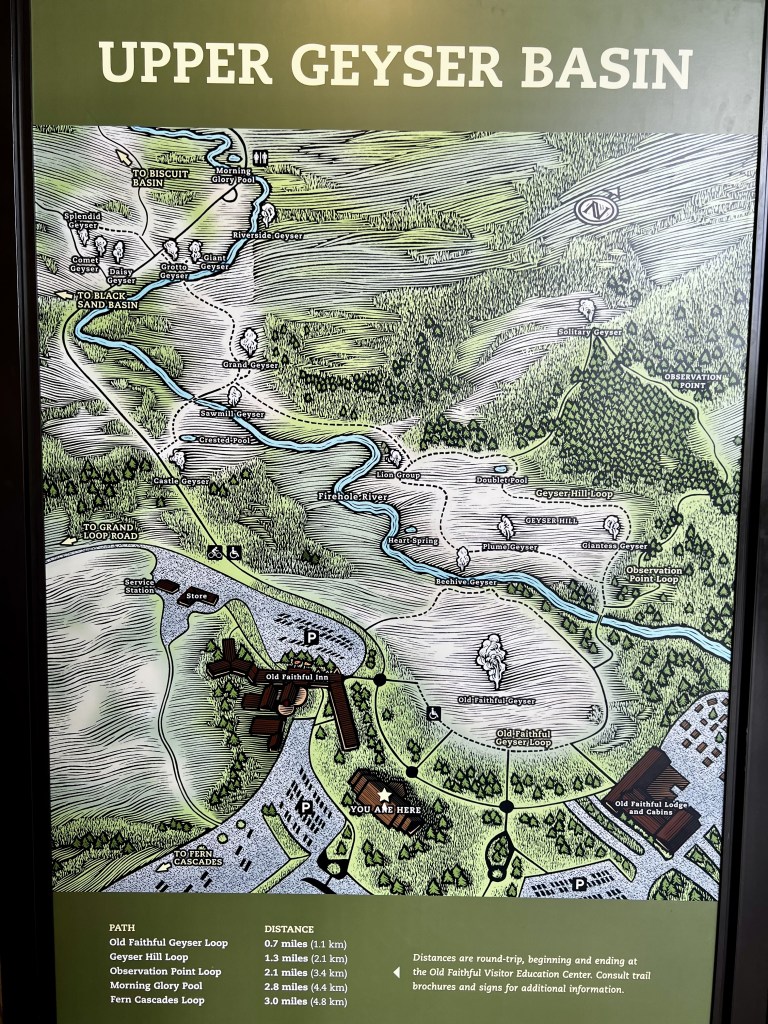
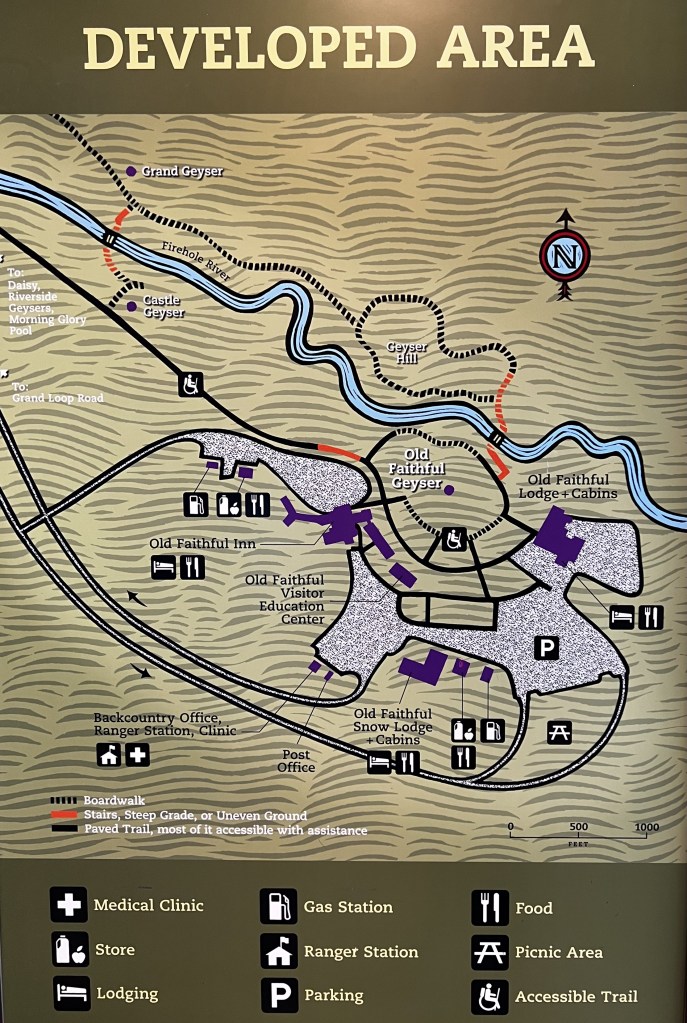
Upper Geyser Basin map including parking and picnic areas.
Directions to the geyser: On your GPS (please download offline google maps), you can add the location to the Old Faithful Inn (3200 Old Faithful Inn Rd, Yellowstone National Park, WY 82190) parking lot. From the parking lot, its. very short walk to the Old faithful Inn and the Geyser. Although there are plenty of spaces to park, we recommend you start early and be there at least 15 to 20 mins before the eruption time.
If possible try to cover this as the very first attraction of the day. During peak times, it will be hard to get a place to view the eruption, so be there early to give yourself plenty of time to settle. You can also get plenty of information at the visitor center including the maps.
You can also do the 0.7 mile Old Faithful Geyser loop trail. For more information, visit https://www.alltrails.com/trail/us/wyoming/observation-point-loop-trail
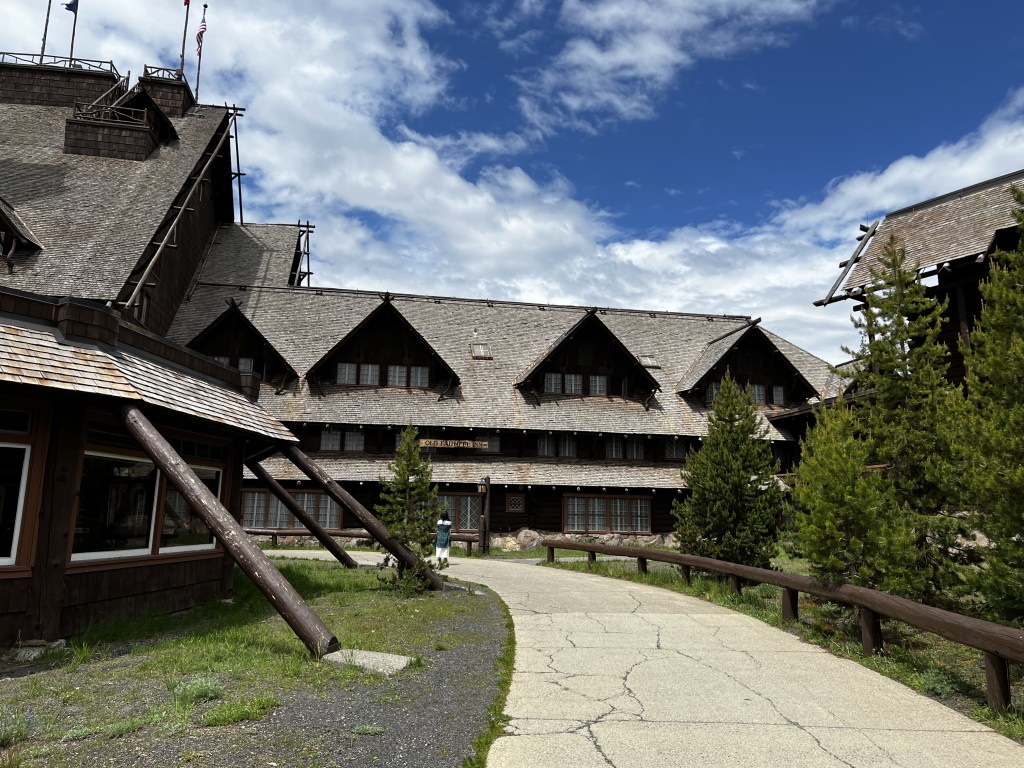


(From left to right: Old Faithful Inn hotel and kitchen area)
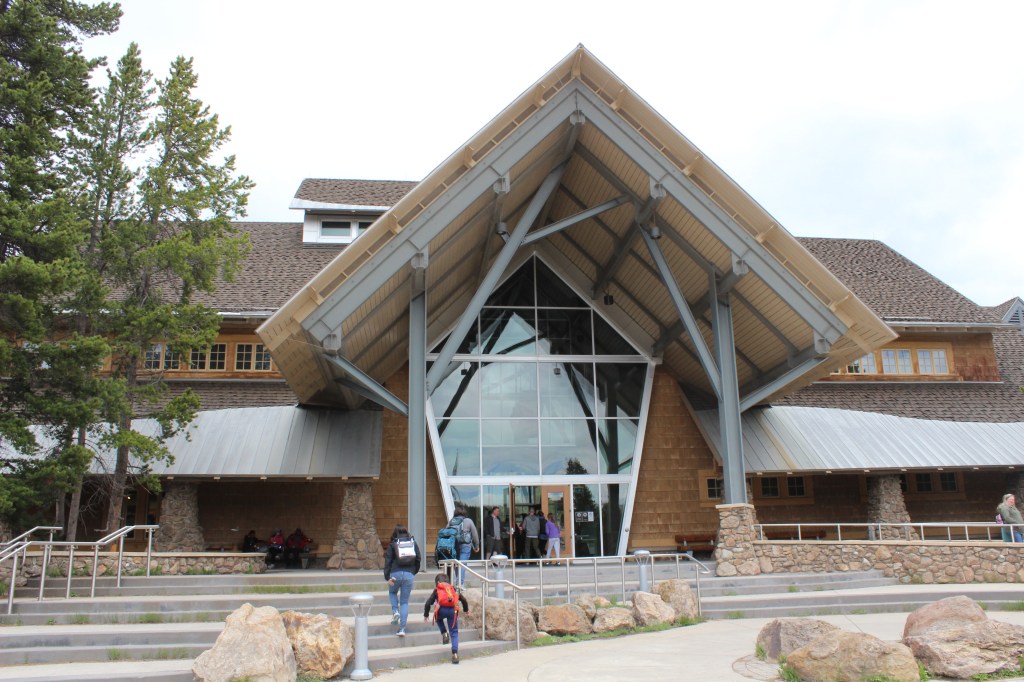

(From left to right: Visitor Center and Faithful Inn hotel lounge area)

- MAMMOTH HOT SPRINGS (ALSO INCLUDED AS SEPARATE ATTRACTION)
Mammoth Hot Springs is a large complex of hot springs on a hill of travertine in Yellowstone National Park adjacent to Fort Yellowstone and the Mammoth Hot Springs Historic District. It was created over thousands of years as hot water from the spring cooled and deposited calcium carbonate (over two tons flow into Mammoth each day in a solution). Because of the huge amount of geothermal vents, travertine flourishes. Although these springs lie outside the caldera boundary, their energy has been attributed to the same magmatic system that fuels other Yellowstone geothermal areas.
Time needed here: Mammoth Hot Springs has both the Upper and the Lower terrace area. Hiking both the areas will take up to approximately 2 hours depending on where you start and end and how much time you spend. We recommend to keep 2 hours to give you sufficient time without having to rush.
Directions: Mammoth Hot Springs was our first attraction since we entered through the North east entrance of the park. The closest town in Gardiner, Montana which is about 5 miles north and the closest entrance is the Roosevelt Arch at the north entrance. Its about (15 mins – 4.9 miles from the Arch).
Good to Know: There are plenty of grasslands around the Mammoth Hot Springs Village area which is also the reason why its the favorite place for Yellowstone Elks now. So you will likely get to see them especially at around dawn or dusk. Mammoth Hot Springs Village area is little town with restaurants, shopping, lodging, fuel, washrooms, a post office and Visitor Center.
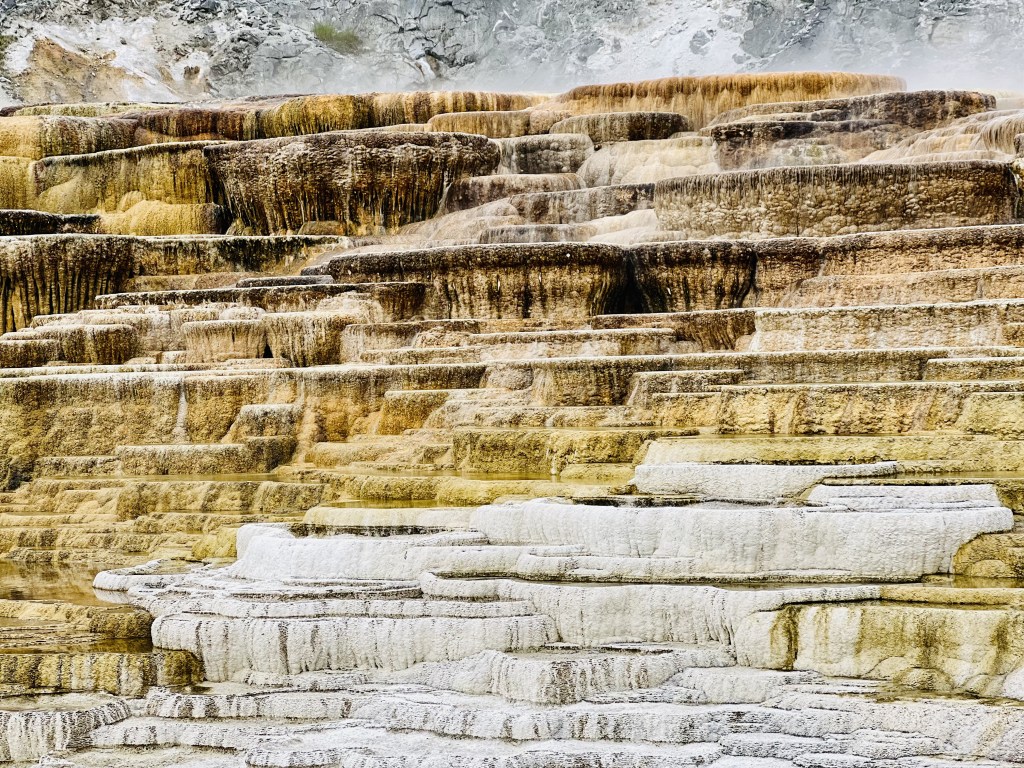
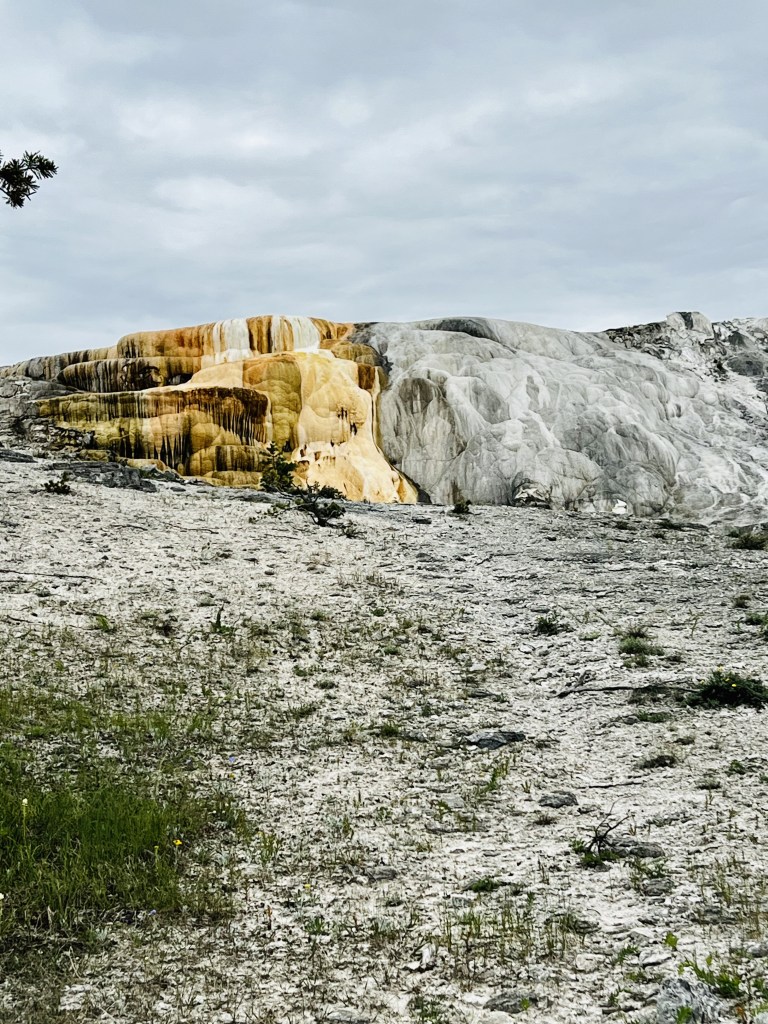
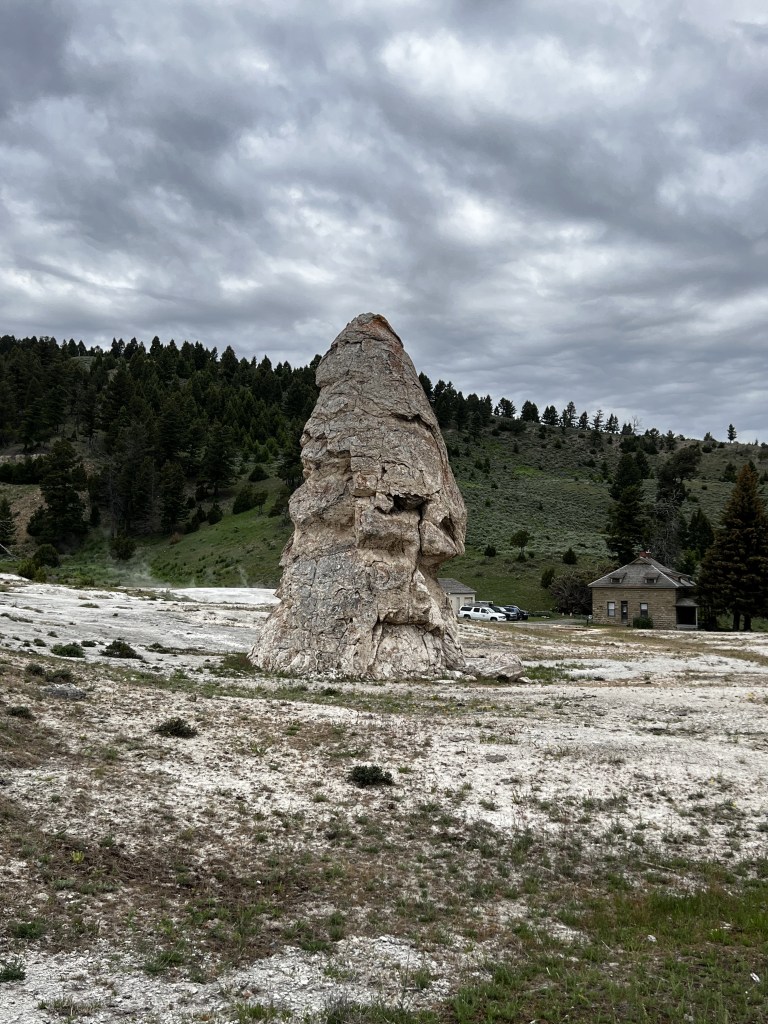
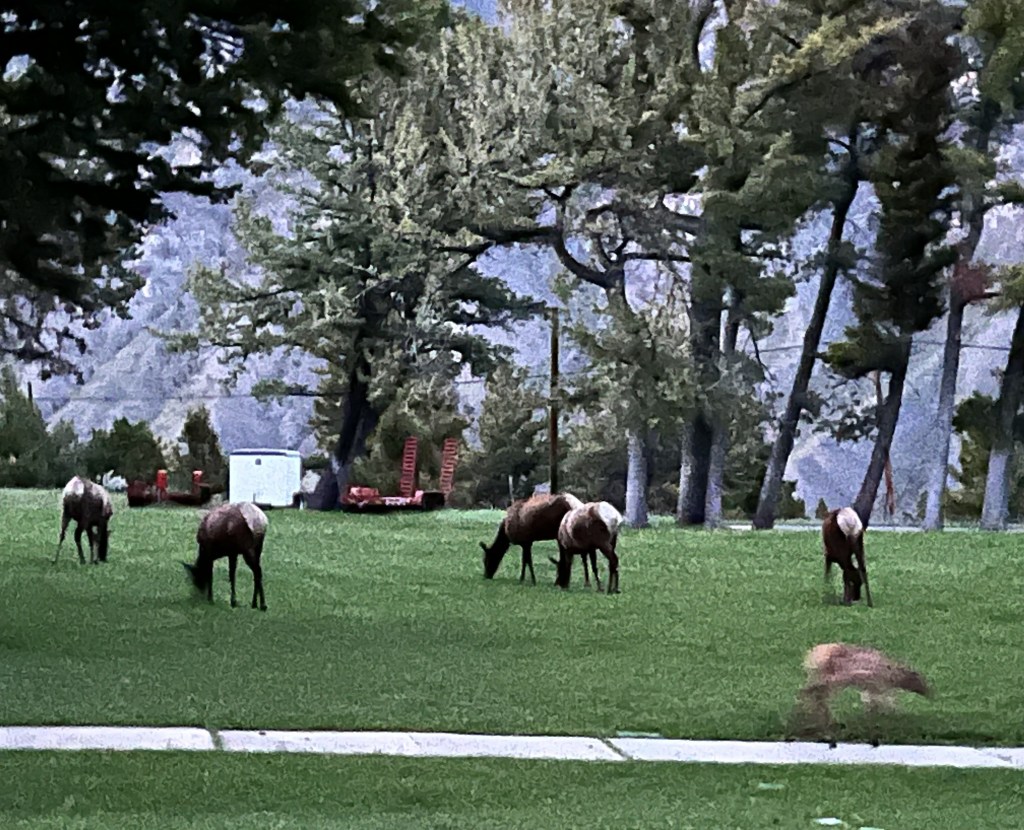
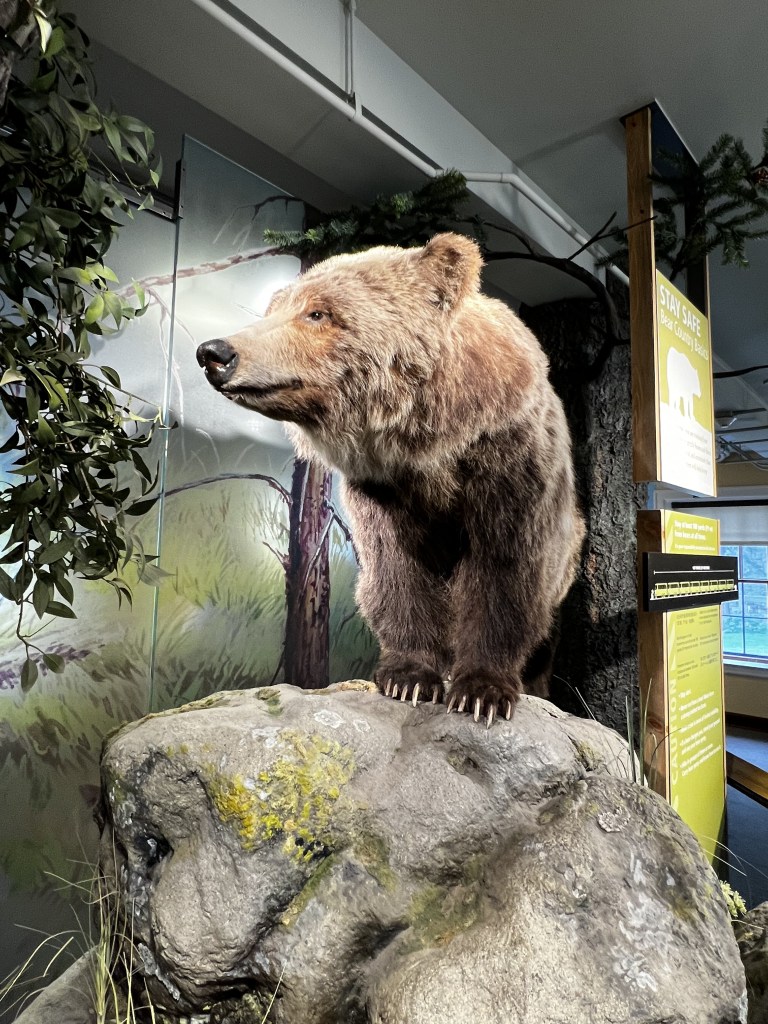

(Left to Right from top – Mammoth Hot Springs, Elks grazing near Mammoth Village visitor center area, Stuffed Bear and Elk displayed at the visitor center museum)
- NORRIS GEYSER BASIN
Steamboat Geyser, in Yellowstone National Park’s Norris Geyser Basin, is the world’s tallest active geyser. Steamboat Geyser has two vents, northern and southern, approximately 20 feet (6.1 m) apart. The north vent is responsible for the tallest water columns; the south vent’s water columns are shorter.
A major eruption of Steamboat Geyser is unforgettable. Water surges from two vents to varying heights, then suddenly water is expelled to more than 300 feet (91 m) high. Curtains of water fall to the slope above the geyser and collect in torrents rushing back into the vents, carrying huge amounts of mud, sand, and rock that are shot skyward again and again. Water coats everything with a glistening layer of silica.
A significant amount of eruption debris can accumulate around the geyser. Even cars in the parking area can be littered with debris.
Directions: You will need to drive to the Norris Geyser Basin parking area and walk short distance to get to the boardwalk. Steamboat Geyser is located on a hillside in Norris Geyser’s Basin and its a 0.25 mile boardwalk starting from the Norris Basin.
Important: There is also a Norris Basin Museum but it was closed when we were there. It is expected to open early 2024.
How much time needed: We recommend an hour here at least if you are planning to complete the entire boardwalk which is about 2.9 miles loop and takes an average of 1hr to complete. But if you are just planning to do Steamboat Springs, you can finish even earlier. We only did Steamboat Geyser. There are plenty of other small hot springs you will see along the loop trail.
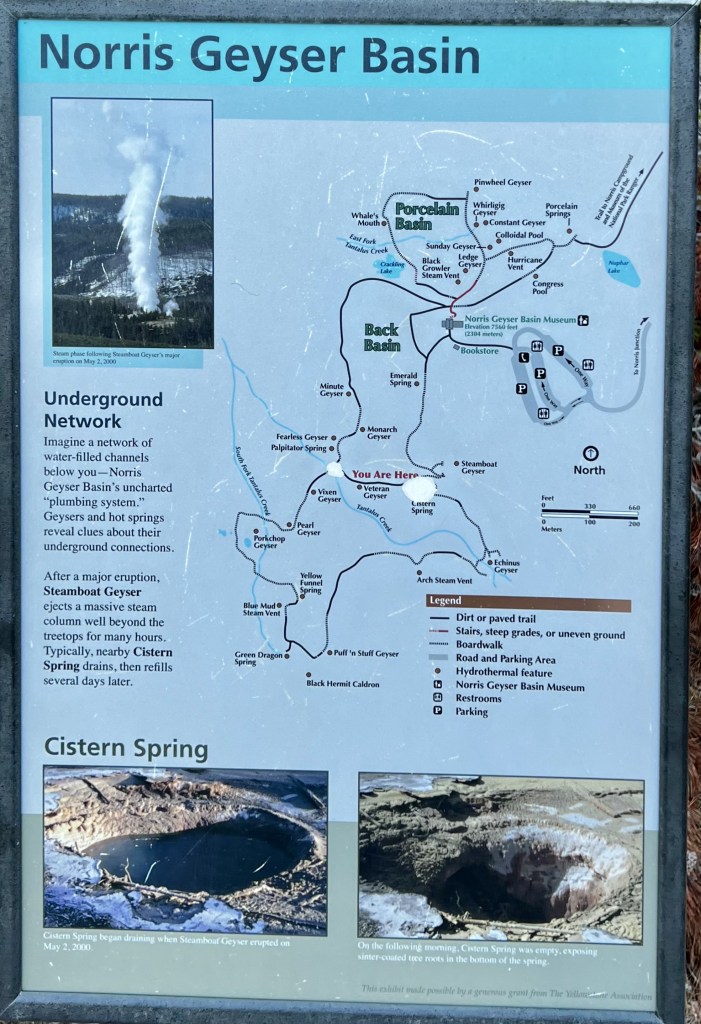
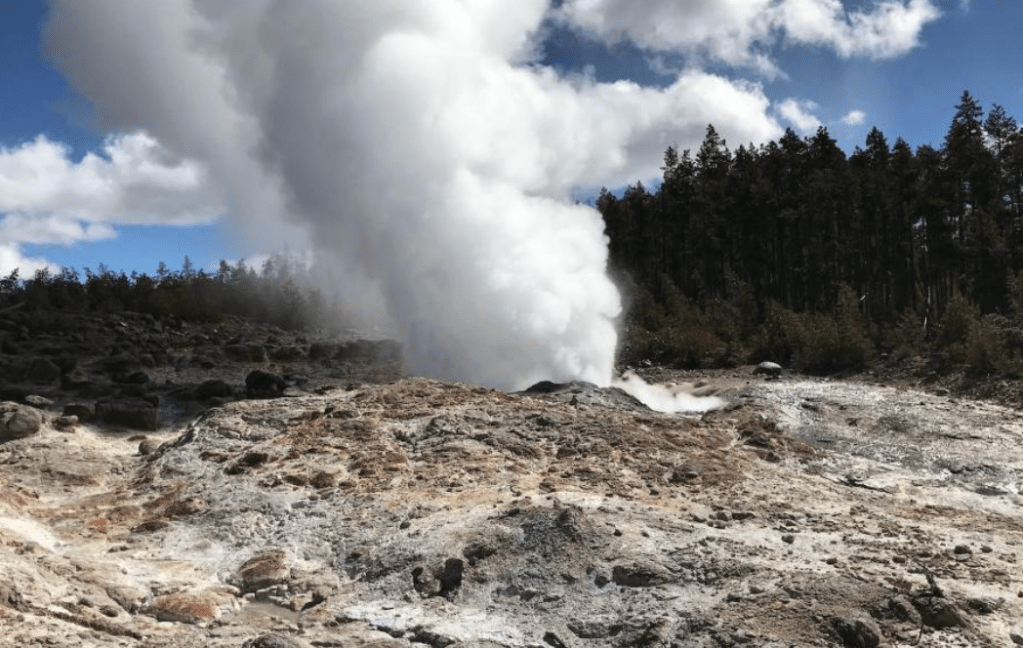
(Norris Geyser Basin Map, Steamboat Geyser – Image Source: NPS)
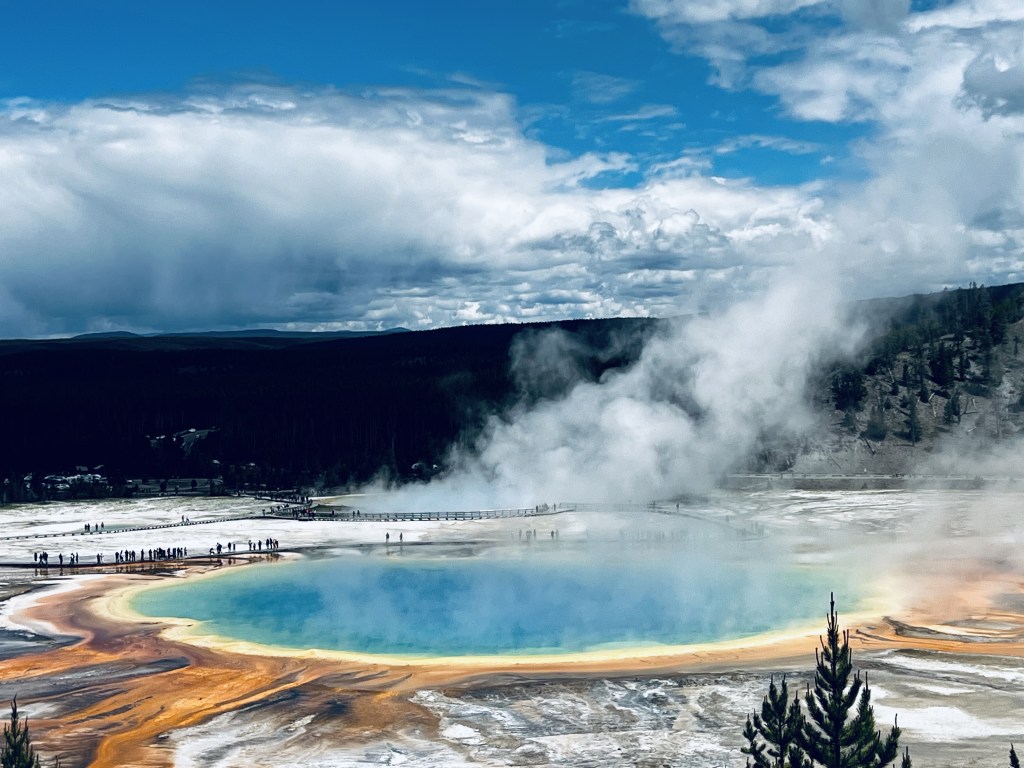
- GRAND PRISMATIC SPRING & OVERLOOK
This was undoubtedly our favorite Hot Springs of Yellowstone National Park. You will need to hike to get to the overlook and the hike was completely worth it. A must visit and we strongly recommend you add this to your Itinerary when you visit the park.
Grand Prismatic Spring in Yellowstone National Park is the largest hot spring in the United States, and the third largest in the world, after Frying Pan Lake in New Zealand and Boiling Lake in Dominica. It is located in the Midway Geyser Basin area.
Directions: You will need to hike to get to the overlook area which is about 1.6 miles round trip with 7270 Feet elevation. Grand Prismatic Spring is located on the western side of the lower half of Yellowstone’s Grand Loop road. It is approximately 6.5 miles from the Old Faithful area. The boardwalk is located at the Midway Geyser Basin. The Overlook is accessed from the Fairy Falls Trail.
How much time needed: You will need about 1.3 – 2 hrs here to find parking and to hike to the overlook.
Important Note: Parking to the trailhead is limited, especially 10 am-6 pm
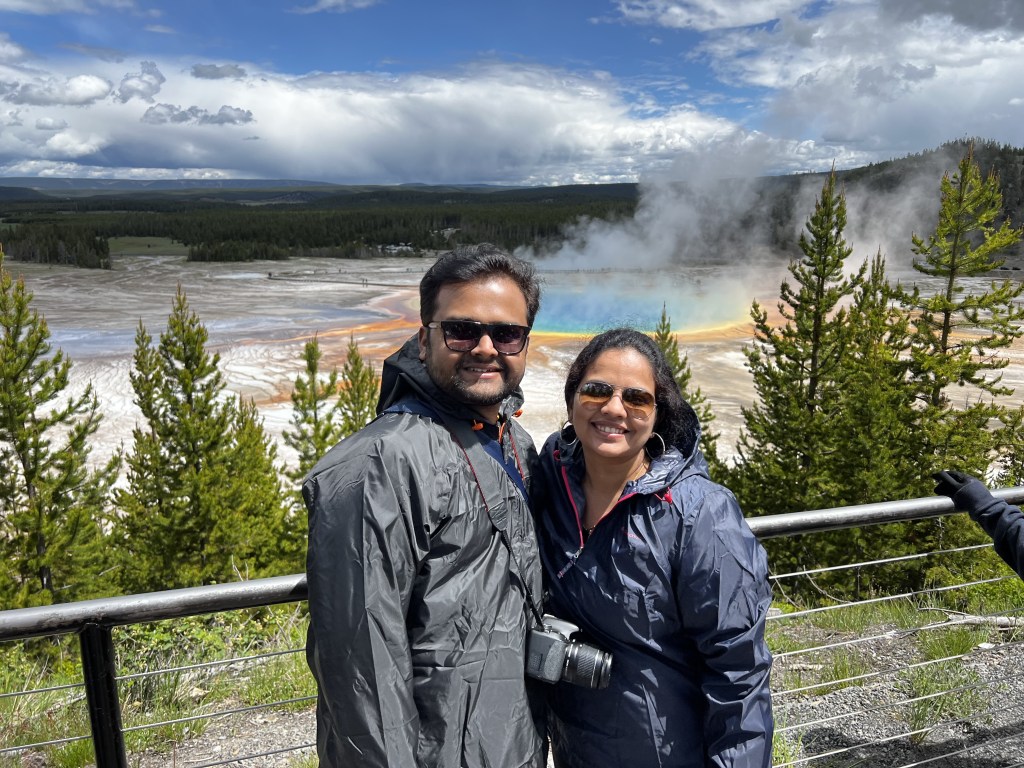
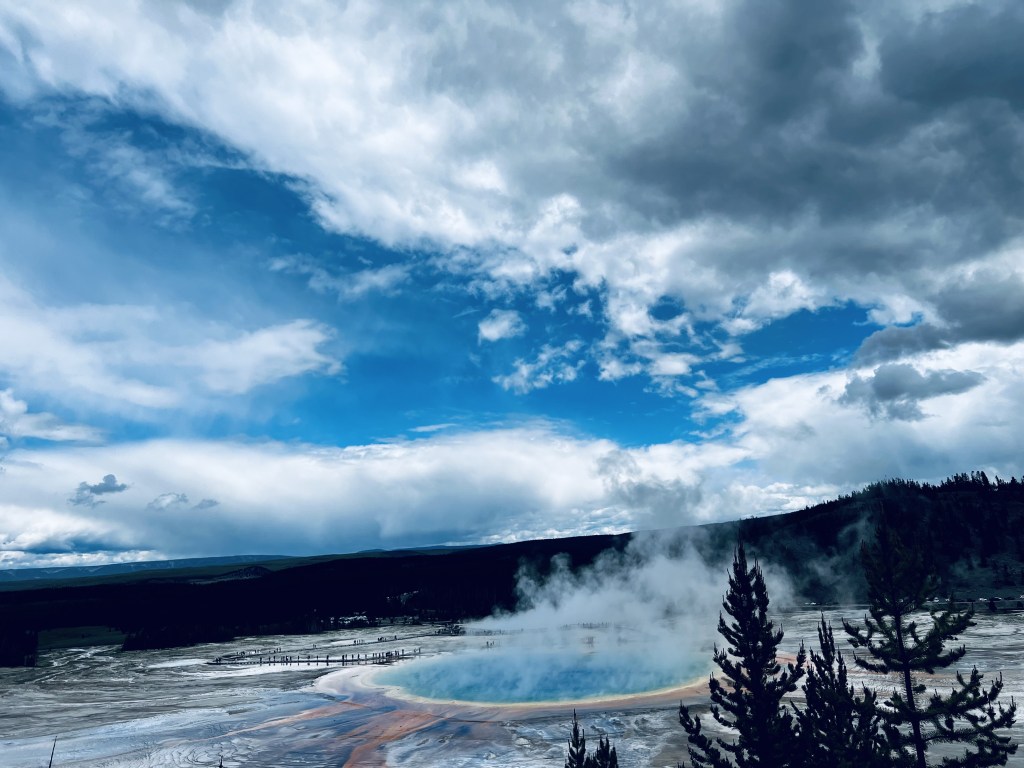
(Images: Grand Prismatic Spring Overlook Area)
- BISCUIT BASIN
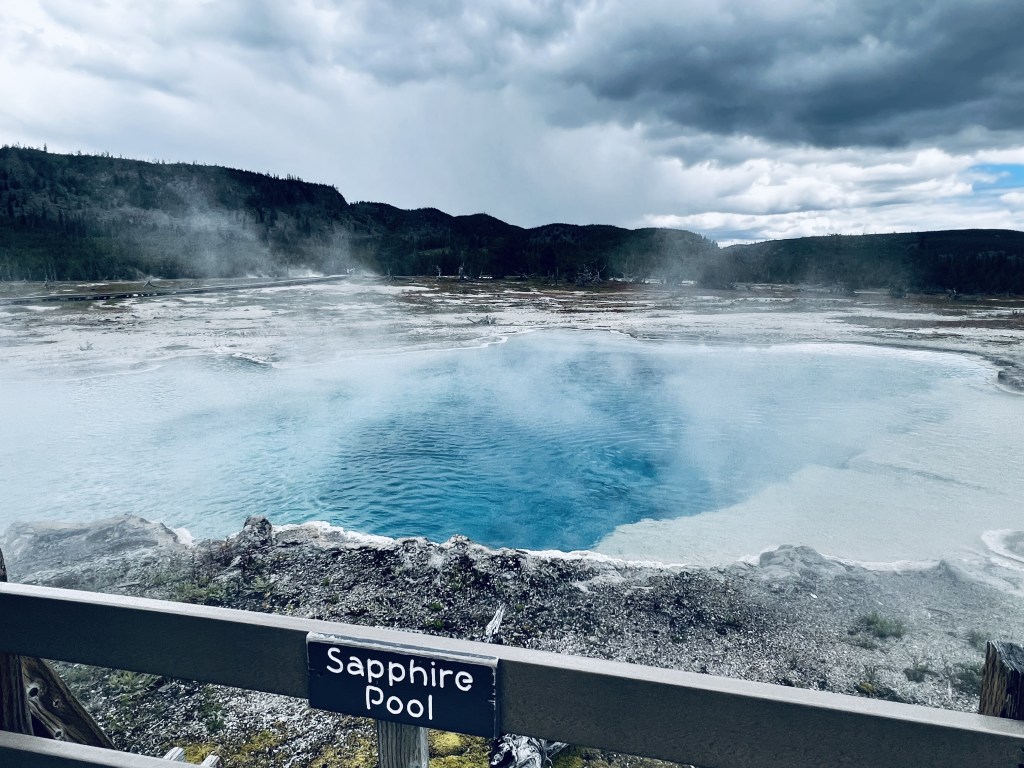
Following the 1959 Hebgen Lake earthquake, Sapphire Pool erupted, and the “biscuits” were blown away. It last erupted in 1991. Sapphire remains one of the most beautiful blue pools in the park. Mustard Spring provides a bright color contrast, and Jewel Geyser erupts every 7-10 minutes.
This is a very short walk around and also the Sapphire pool is great. Its definitely worth the short hike. You will have to park your car at the parking lot area. Plan to arrive early as the parking lot can get full very quickly.
Directions: Biscuit Basin is traversed by an easy 0.6-mile (1-km) lollipop loop boardwalk trail, which leads past many fascinating hydrothermal features, such as Sapphire Pool, Avoca Spring, and Jewel Geyser. The biscuit basin is also very close to Old Faithful and about 10 mins drive from the hotel.
How much time needed: We recommend about half hour here to cover just the lollipop loop boardwalk.
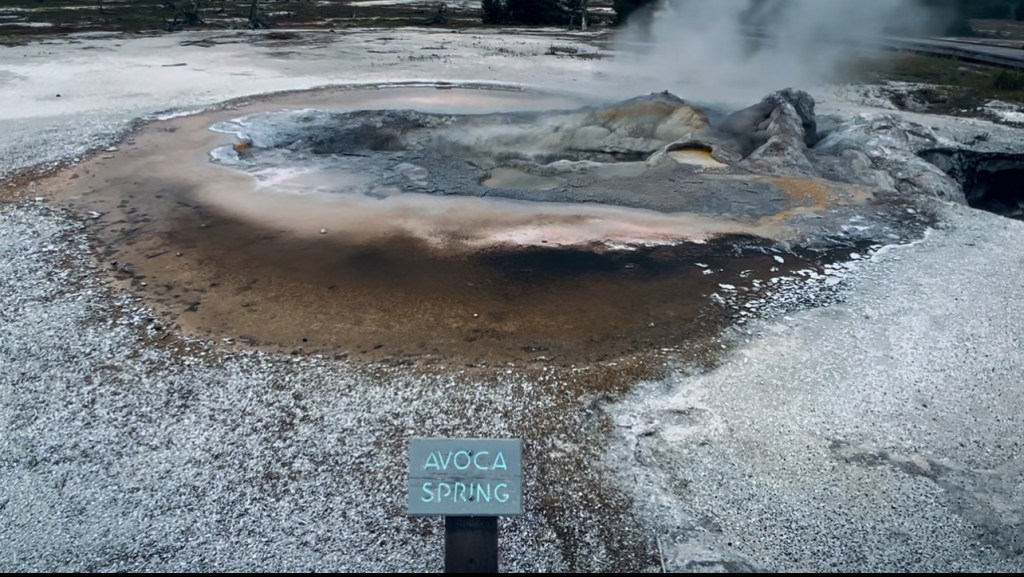
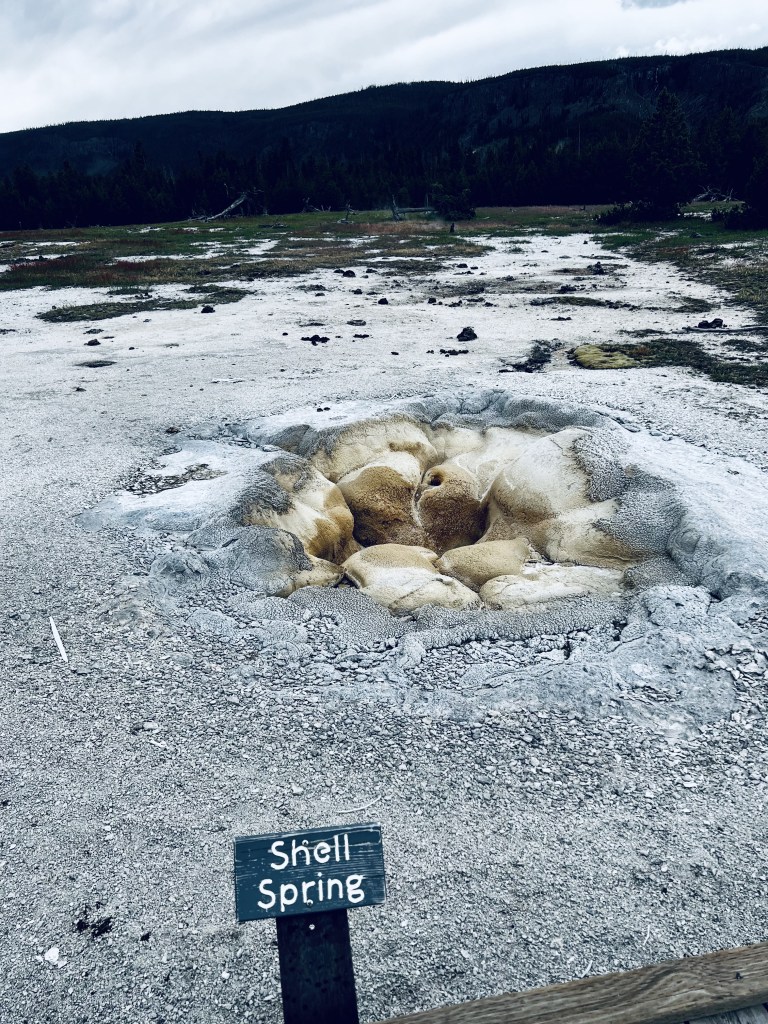
- WEST THUMB GEYSER BASIN
West Thumb Geyser Basin is the largest geyser basin on the shores of Yellowstone Lake. The heat source of the thermal features in this location is thought to be relatively close to the surface, only 10,000 feet down! The West Thumb of Yellowstone Lake was formed by a large volcanic explosion that occurred approximately 150,000 years ago (125,000-200,000).
This geyser is also right on the shores of Yellowstone Lake and the boardwalk adventure is perfect for small children, and it’s wheelchair friendly as well which is also the reason why its heavily crowded and very popular. Along the trail, you will come across many hot springs. We only did the Black Pool, Abyss Pool, Fishing Cone, Lakeshore Geyser and Bluebell Pool.
The parking area is right near the trail head and you will also find information station and restrooms here. Please plan to arrive early as the parking can get filled up quickly during peak times.
Directions: West thumb geyser basin is located just right off the south entrance of the park, to the east.
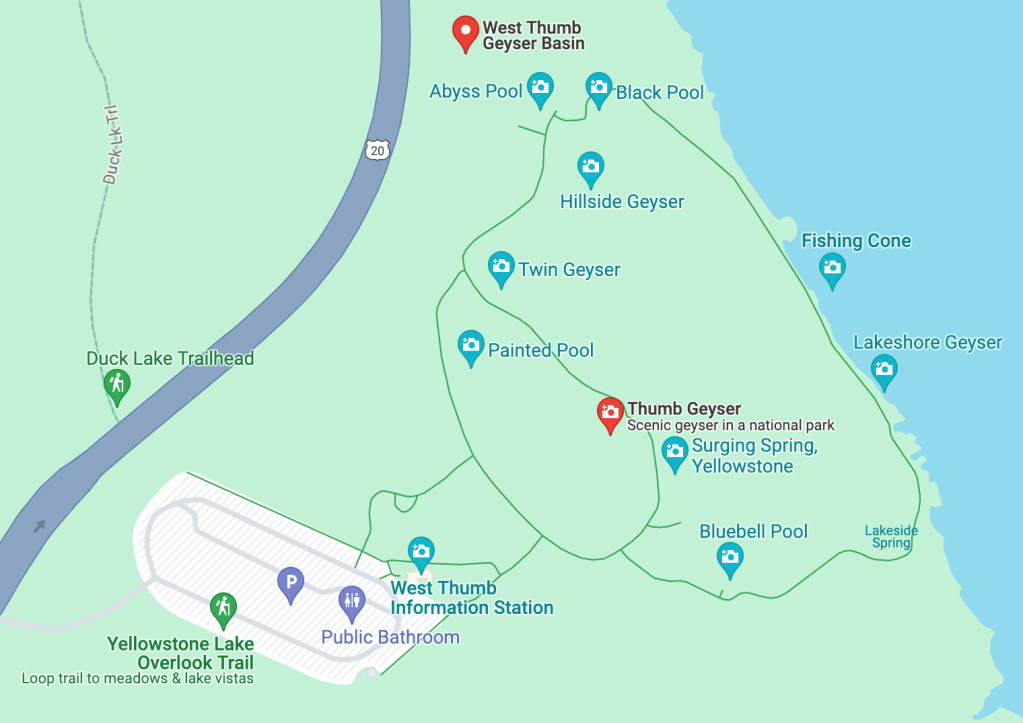
West Thumb Geyser Basin – Map View (Source: Google Maps)

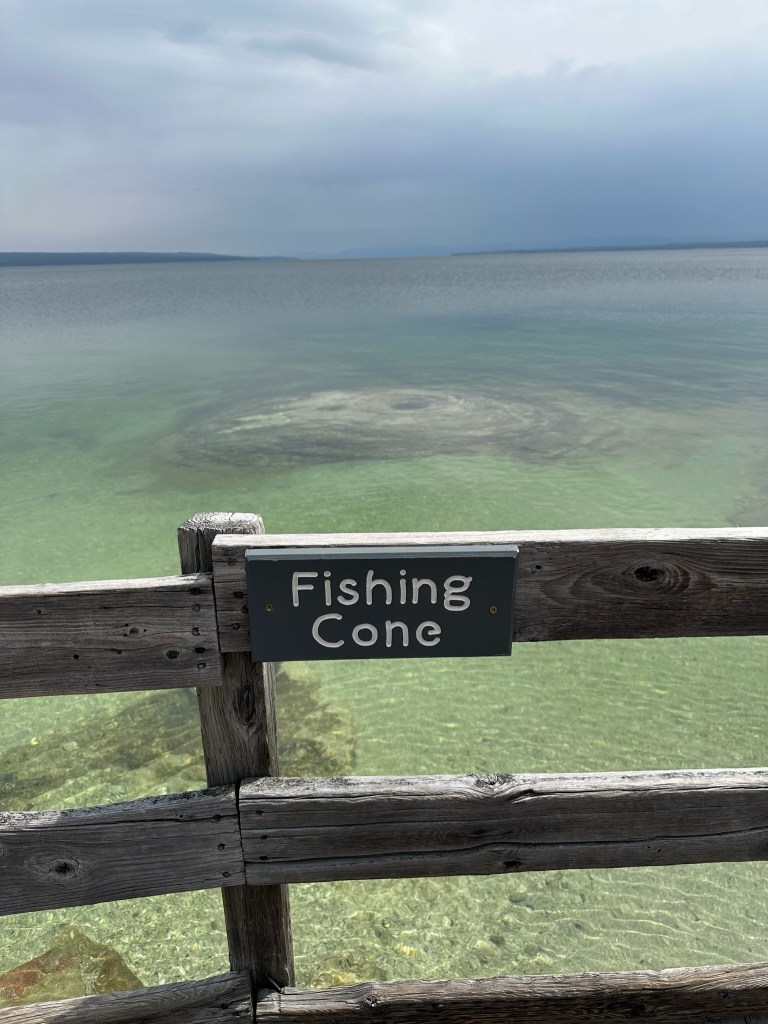

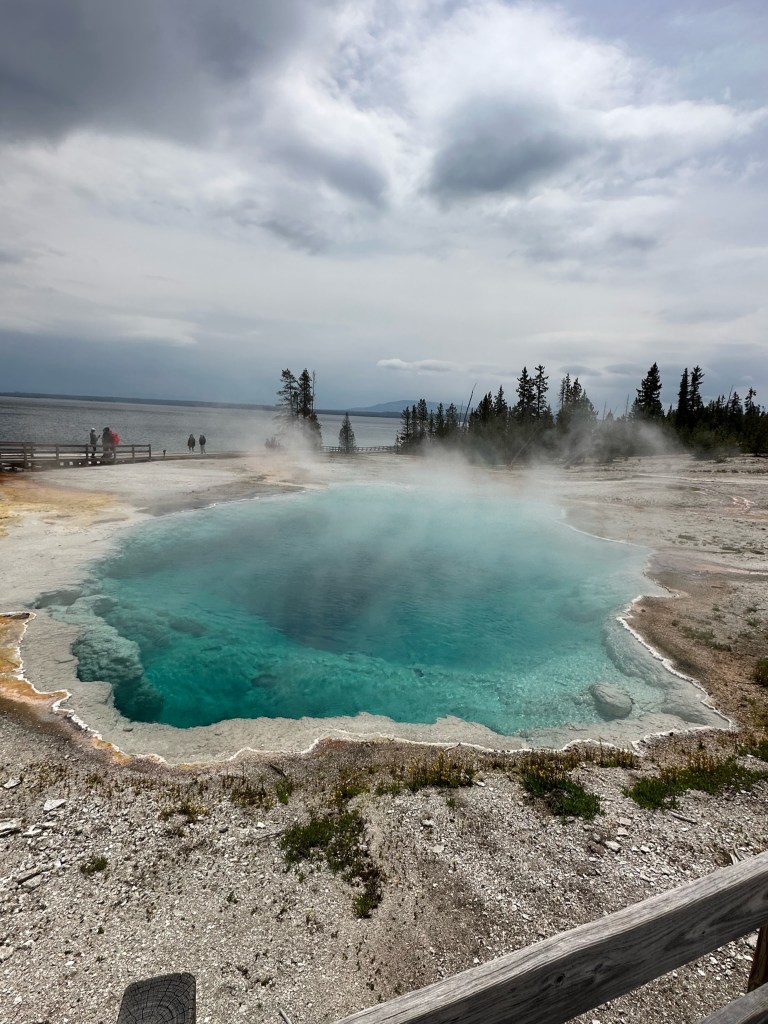
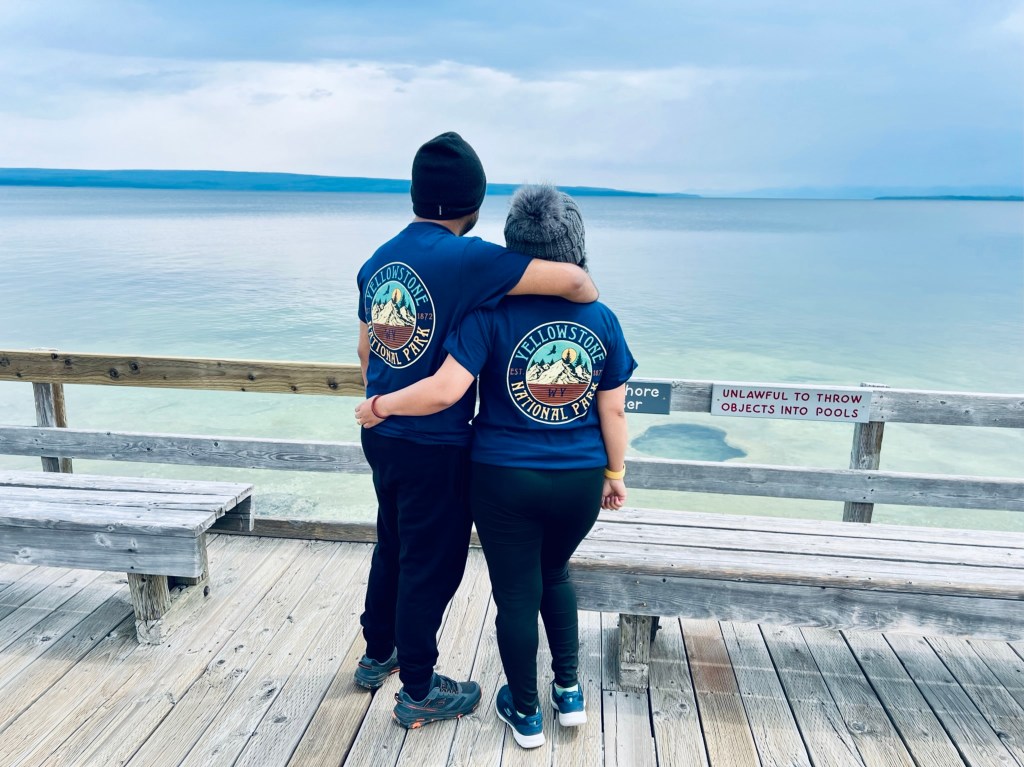
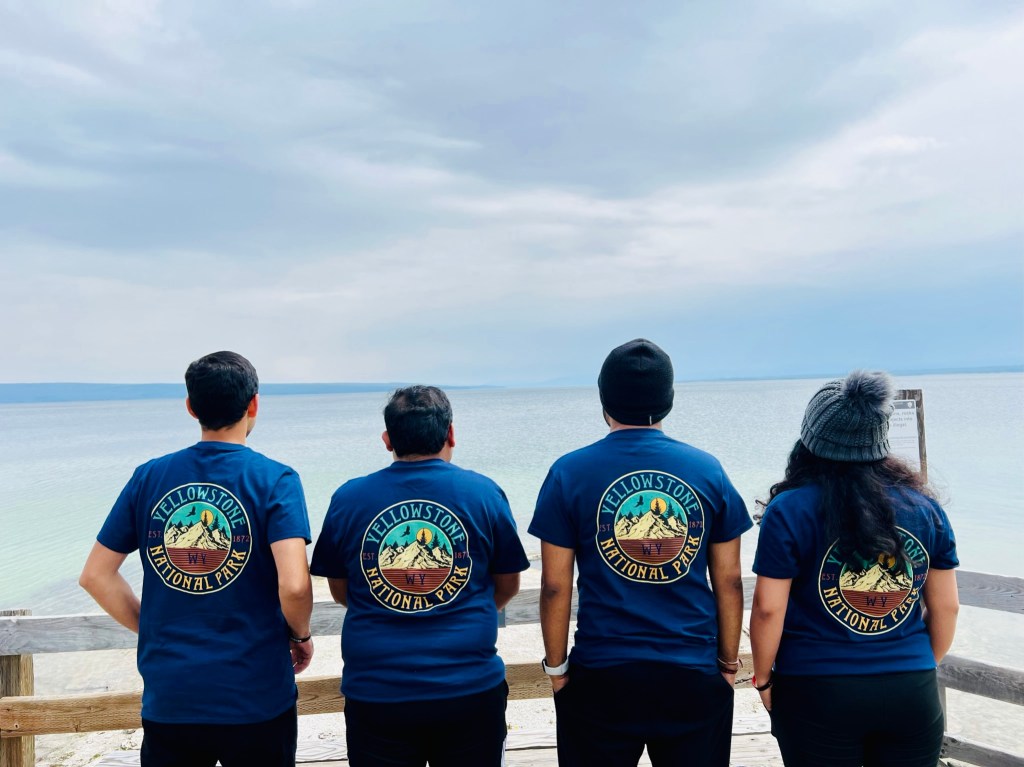
How much time needed: The basin loop trail is 0.6 – 1 mile with the connector trail in the middle. We recommend an hour here.
- MUD VOLCANO
The Mud Volcano area has many mudpots and hillsides strewn with trees cooked by steam. The hydrothermal features here are some of the most acidic in the park. Mud Volcano is near the greatest uplift and sinking of the Yellowstone Caldera floor. Many faults converge here and earthquakes are common.
Mudpots are acidic features with a limited water supply. Some microorganisms use hydrogen sulfide, which rises from deep within the earth, as an energy source. They help convert the gas to sulfuric acid, which breaks down rock to wet clay mud and creates the area’s smell. The pungent odor of rotten eggs is caused by the hydrogen sulfide gas.
Various gases escape through the wet clay mud, causing it to bubble. Mudpots consistency and activity vary with the seasons and precipitation.
Directions: The parking to the boardwalk is right along the grand loop road. This boardwalk is also close to the West thumb geyser basin.
How much time needed: You can hike the 0.8 mile loop trail near West Yellowstone, Montana. It takes an average of 21 min to complete.
Directions: You will need to drive 5.9 miles north of Fishing Bridge Junction, or 9.7 miles south of Canyon Junction on the Canyon to Fishing Bridge section of the Grand Loop Road to reach Mud volcano.
Time needed: You will need about half hour here.
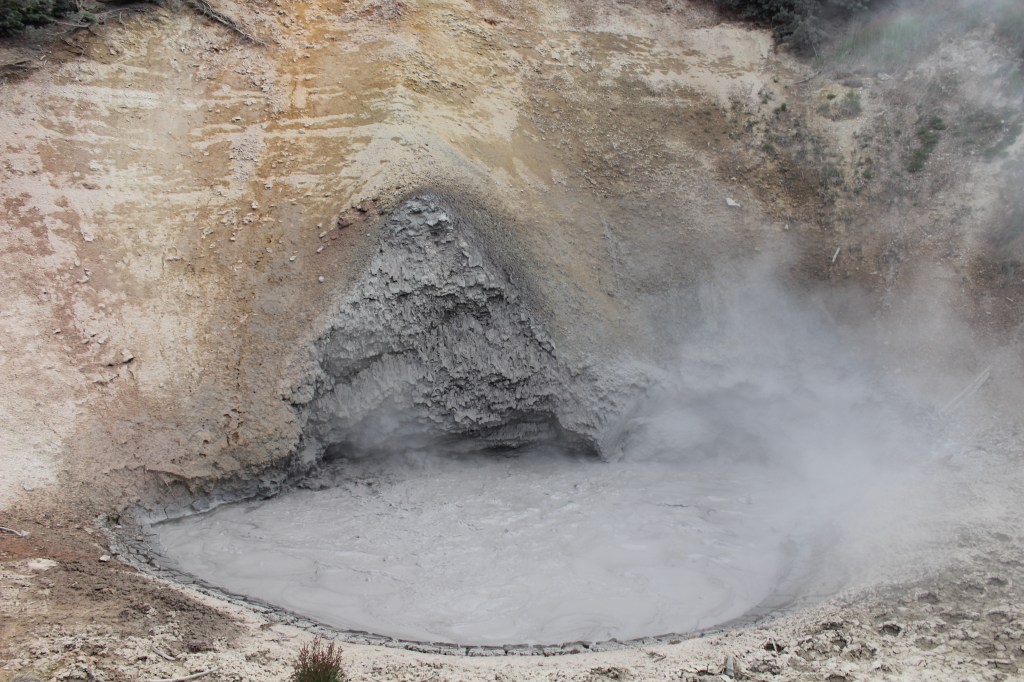
Mud Volcano
Mystic Falls
We actually couldn’t visit the Mystic Falls area but will give you sufficient information you will need to include this in your Itinerary. Mystic falls starts at the biscuit basin near Old Faithful area. Mystic Falls tumbles roughly 70 feet along a series of ledges on the Little Fire hole River. Below the falls the river cuts through a small, but ruggedly beautiful canyon.
Note: This is not a very common hiking area in Yellowstone, which is why you might experience lesser crowds.
Directions to the trailhead: Walk 0.3 miles to the far side of the Biscuit Basin boardwalk to the trailhead or begin 0.25 miles (0.4 km) south of Biscuit Basin by parking in pullouts on either side of the road and walking 0.5 miles north along the Upper Geyser Basin–Biscuit Basin Trail to the trailhead.
Just the mystic falls trail is 2.4 miles out and back and it takes about an hour to complete. Usually people recommend to keep 2 hrs for this trail.
Parking: At the biscuit basin trailhead parking. Although this parking space is limited, it can still get filled up very quickly during peak summer times. So plan accordingly.
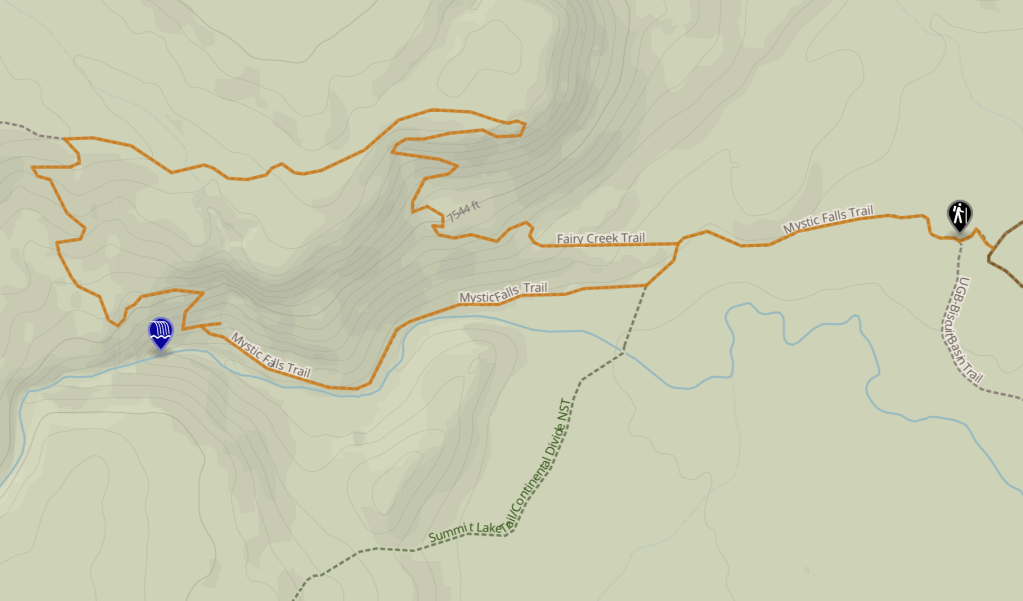
Mystic Falls Trail Area Map – Source: NPS website
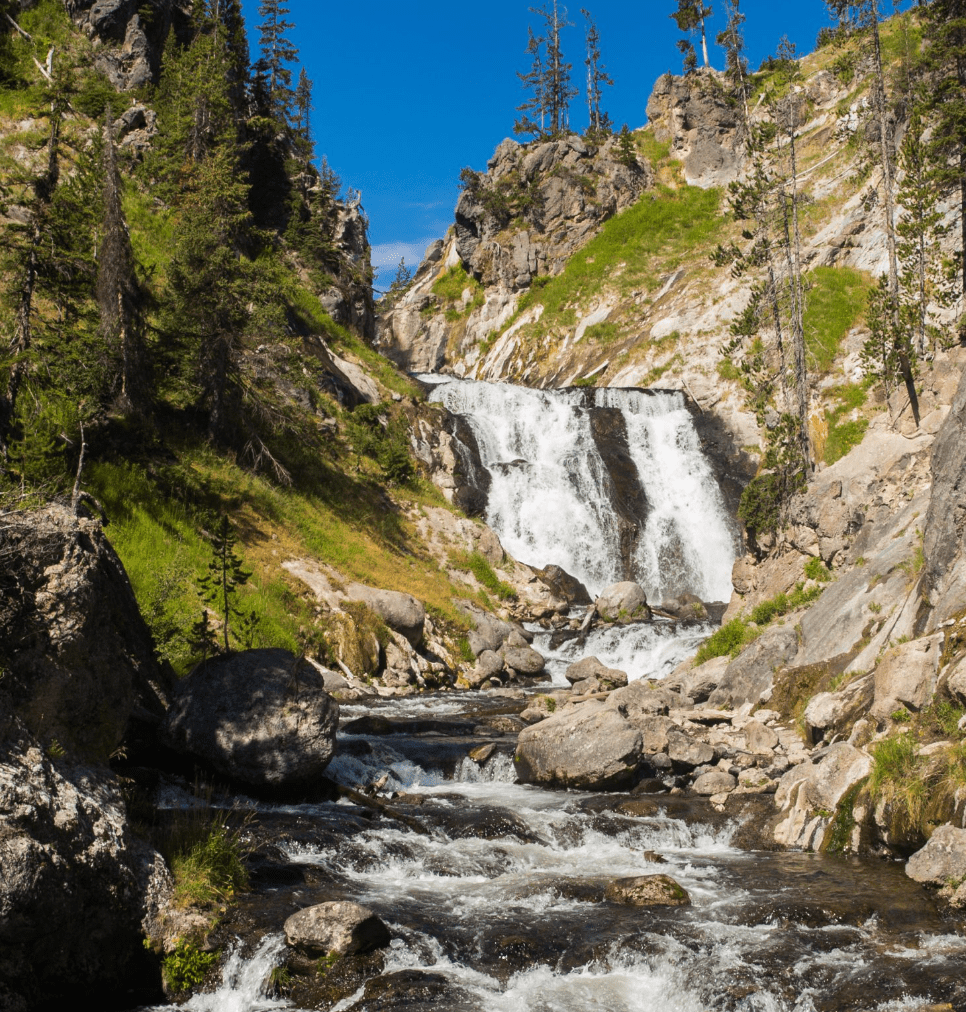
Mystic Falls (Image Source: Google Images)
Lewis lake and Falls
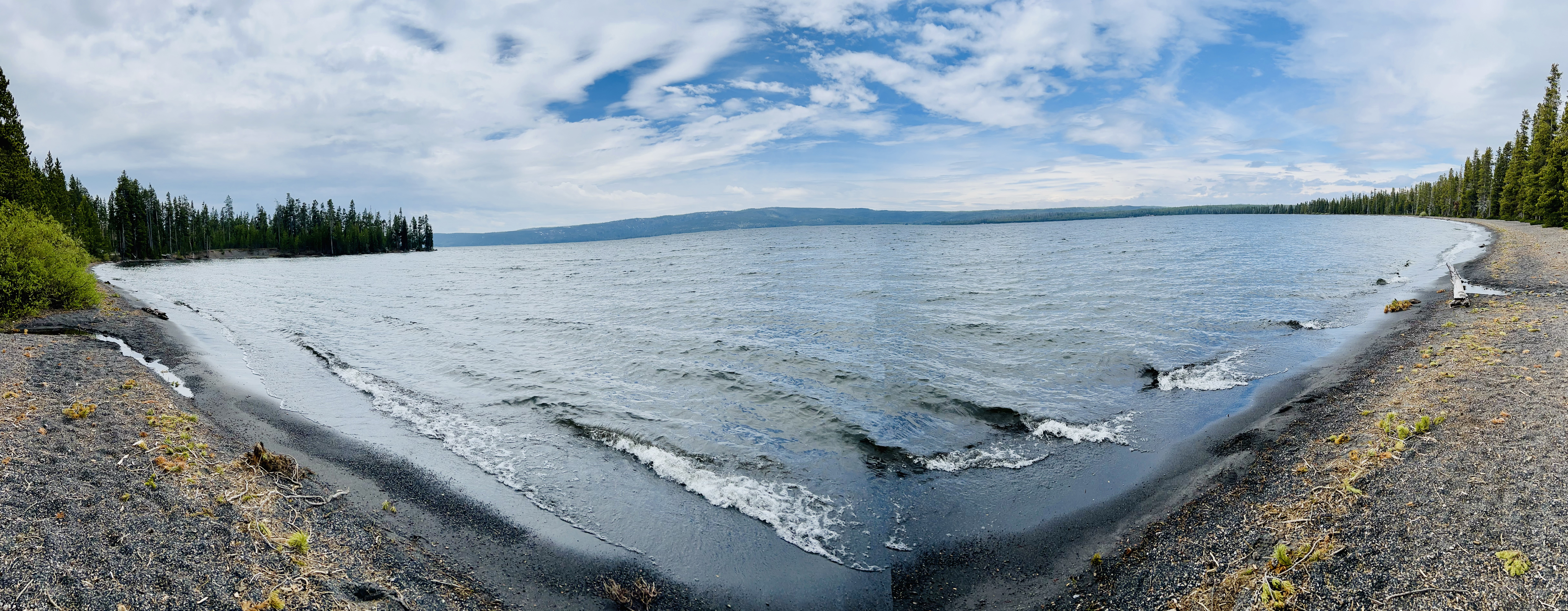
Lewis Lake is located in the southern part of the park. The lake’s picturesque surroundings, characterized by dense forests and breathtaking mountain vistas, make it a popular destination for outdoor enthusiasts. Anglers are particularly drawn to Lewis Lake for its abundance of trout, including Yellowstone cutthroat trout, lake trout, and brown trout. Fishing from boats or the shoreline is permitted, subject to park fishing regulations.
While motorized boats are not allowed on Lewis Lake, non-motorized watercraft such as canoes and kayaks provide a peaceful means of exploration. The lake’s calm waters are ideal for paddling and offer opportunities for visitors to enjoy the serenity of this natural gem.
How to get here:
- From the West Entrance: Follow the Grand Loop Road eastward for approximately 16 miles until you reach the South Entrance. From there, continue for about 7 miles and turn left onto the Lewis Lake Road. Follow this road for approximately 9 miles until you reach the lake.
- From the South Entrance: Drive north on the Grand Loop Road for approximately 7 miles and then turn left onto the Lewis Lake Road. Continue for about 9 miles to reach the lake.
Lewis Falls is a beautiful waterfall in the park and it is named after Meriwether Lewis, who explored the area during the famous Lewis and Clark Expedition. The waterfall is known for its impressive cascade and picturesque surroundings, making it a popular destination for nature lovers and photographers.
Directions to get to the falls: Lewis Falls is one of the first waterfalls you will see while driving into the park through the South Entrance. It is a 30 foot falls which can be seen by parking in one of the roadside pullouts nearby and walking onto the bridge that goes over the Lewis River.
The amount of time needed to explore Lewis Falls can vary depending on your interests. If you simply want to admire the waterfall and take some photographs, a visit of 15 minutes should be sufficient.
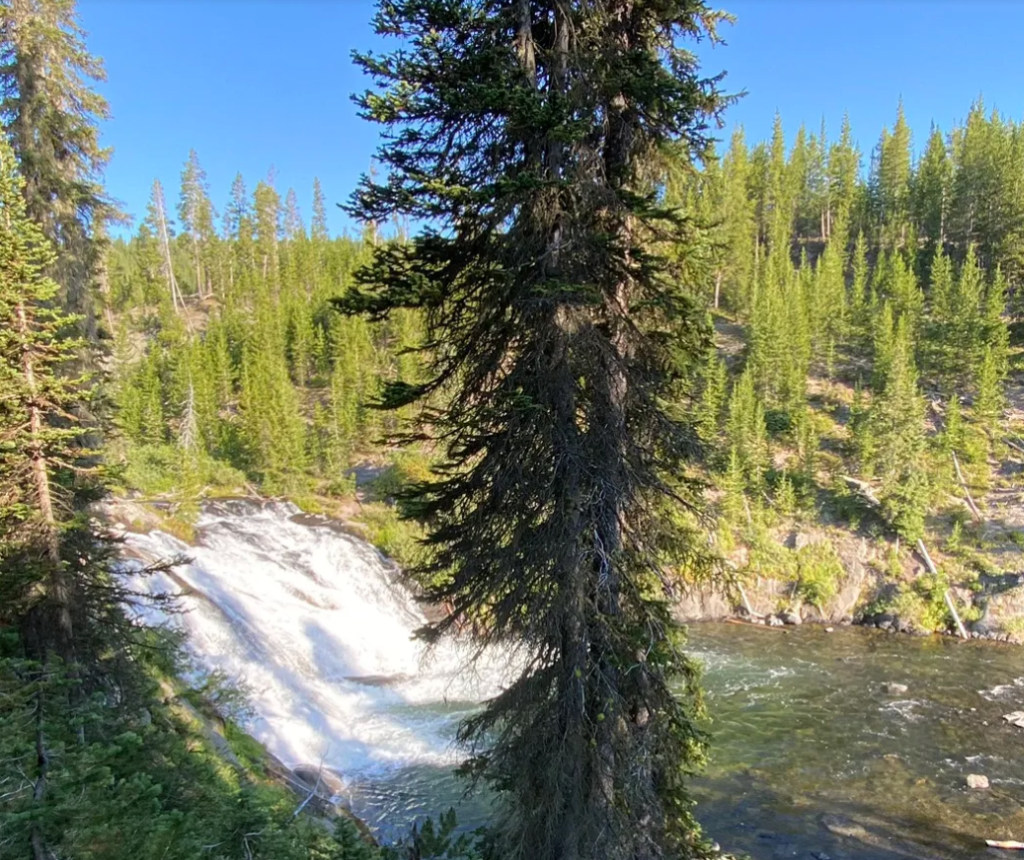
Lewis Falls (Source: Google Images)
Yellowstone Lake
Yellowstone Lake is the largest body of water in Yellowstone National Park. The lake is 7,732 feet (2,357 m) above sea level and covers 136 square miles (350 km2) with 110 miles (180 km) of shoreline. While the average depth of the lake is 139 ft (42 m), its greatest depth is at least 394 ft (120 m). Yellowstone Lake is also the largest freshwater lake above 7,000 ft (2,100 m) in North America.
Yellowstone Lake has the largest population of wild cutthroat trout in North America. The Yellowstone river flows into and out of Yellowstone lake.
Directions: You can drive around the Grand Loop Road which surrounds the Yellowstone Lake and West Thumb Basin area. The entire Grand Loop Road takes about 4 to 7 hours to drive depending on the traffic. Note: You don’t have to drive the entire loop to see the lake.
How much time needed: Depending on how much you want to explore and how much time you will take at each attraction along the loop road, it could take anywhere between an hour to couple of hours. We recommend at least an hour to get a good view of the lake area and to take some nice pictures with your friends or family.

Yellowstone Lake Area Map (Source: Google Maps)

Southeast arm of Yellowstone Lake (Image Source: NPS)
Note: If you are interested to know more on the history, Archaeology of the lake, you can check on the NPS website.
Moose Falls
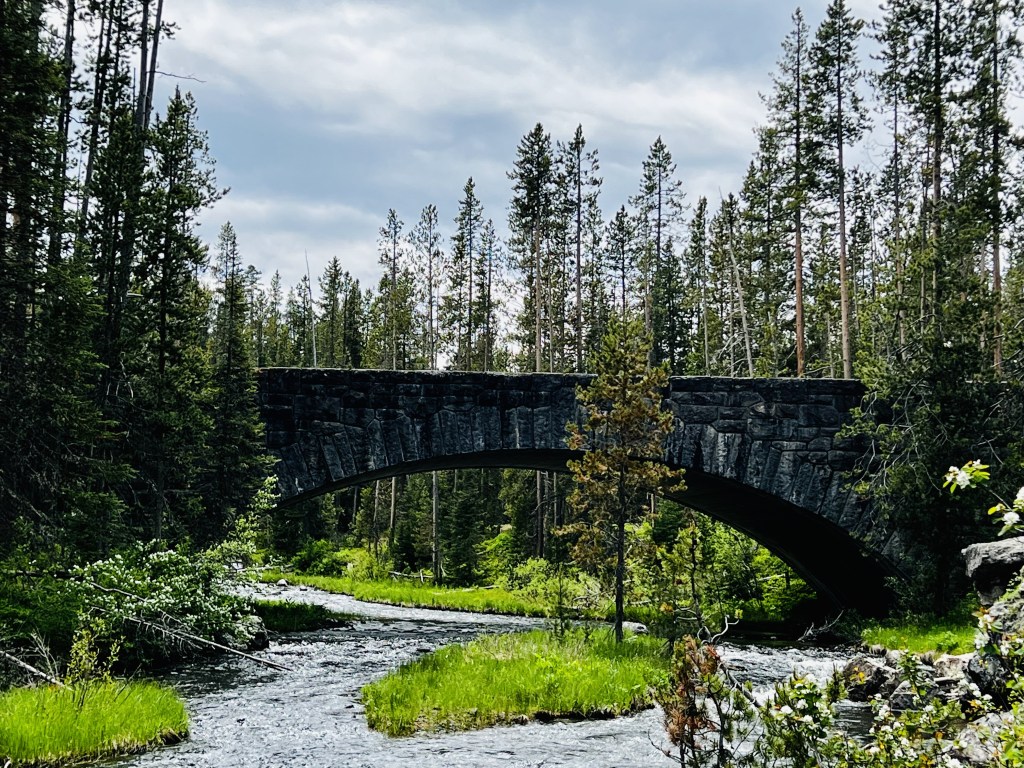
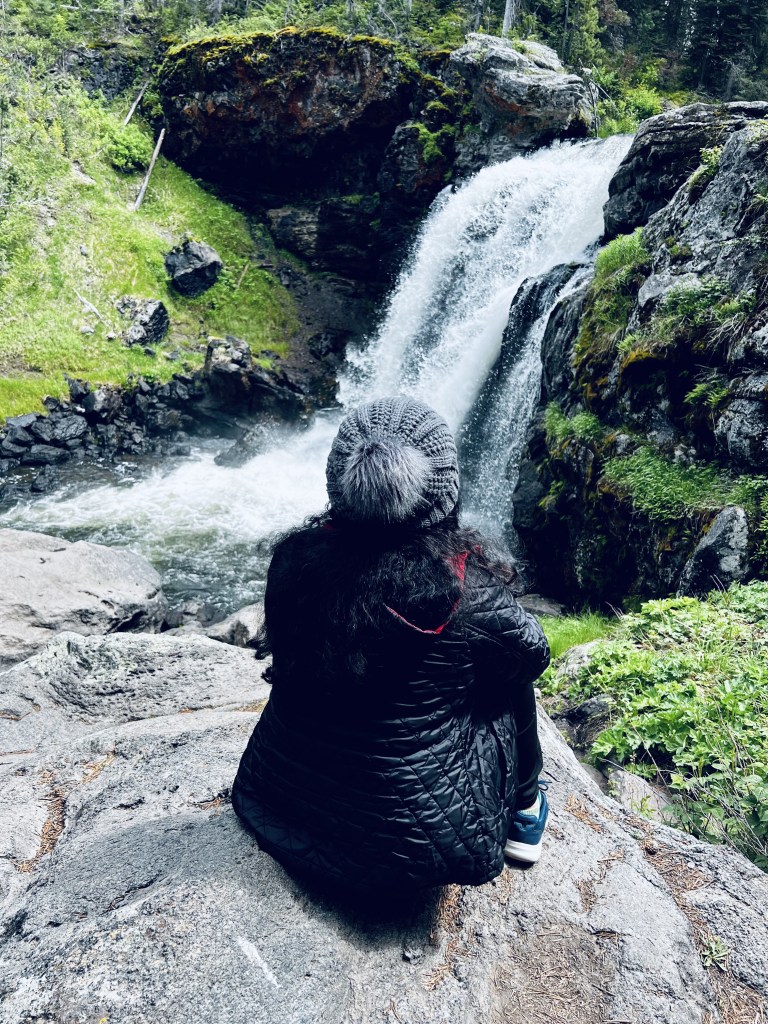
Images from left to right: Bridge near Moose Falls area and the Moose Falls
Moose Falls is a small 30 ft plunge type waterfall located near the south entrance of the park. It was once referred to as “Crawfish Falls” since its sitting on the creek with the same name.
Directions: Moose Falls is pretty close to the South Entrance road of the park and its a 0.1 mile out and back trail and takes about 5 – 10 mins to complete.
How much time to spend here: There is nothing much to see apart from just admiring the waterfalls itself. We recommend about 10 – 15 mins here.
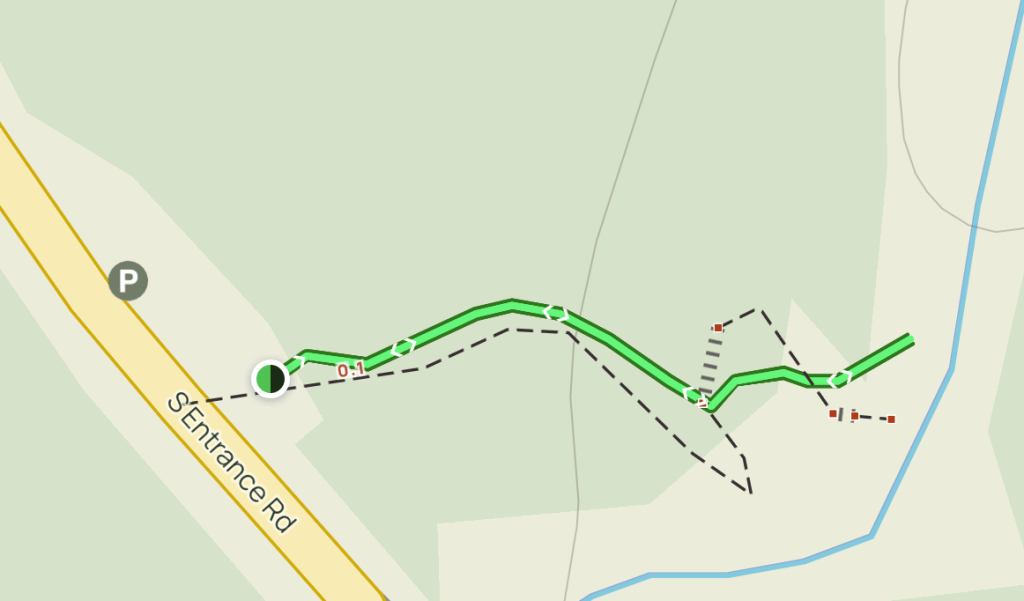
Moose Falls Map Area (Source: Alltrails)
Viewing Wildlife
Yellowstone is known for its abundant wildlife. With its wide-open meadows and vast grasslands, its a perfect habitat for bison, elk, bears, moose, wolves, bighorn sheep, and many other species of animals. There are nearly 300 species of birds, 16 species of fish, five species of amphibians, six species of reptiles, and 67 species of mammals—including seven native ungulate species and two bear species in Yellowstone.
Where to view Wildlife: Although Yellowstone is known for its wildlife, its not that you can view them easily, except for Bisons. When we visited Yellowstone with our cousins, we did not see any wildlife on our first day except for Bison.
Bisons are like the Welcome Committee of Yellowstone and you can see them almost everywhere like on every other grassland areas in the park. Although be careful and make sure you give them plenty of space. These animals are ferocious and trying to get too close to them, can be very fatal.
Below are some of the popular destinations in the park to view wildlife. (Courtesy of NPS)
- Fishing Bridge: Grizzly bears
- Hayden Valley: Bison, black bears, elk, grizzly bears, wolves
- Lamar Valley: Bison, black bears, bighorn sheep, elk, grizzly bears, mule deer, pronghorn, wolves
- Mammoth Hot Springs: Bison, black bears, elk, mule deer
- Madison: Bison, elk
- North Entrance: Bighorn sheep, bison, elk, pronghorn
- Northeast Entrance: Moose
- Old Faithful: Bison, elk
- South Entrance: Moose
- West Thumb: Elk, moose
When to view wildlife: Summer is always the best time to see wildlife. We went in June, but we thought it would have been better if we had travelled sometime in August or early September especially for the bears when they are very active before going to hibernation.
Animals in the park are active at dawn and dusk. There is nothing like perfect time to view them but your chances to see the wildlife is more when you go very early in the morning or later in the evening. Also from our experience and from what we have observed, somewhere around 6:15 – 6.45AM or till 7.15 AM is the ideal time to have more chances of seeing them. You will have to be at the right place at the right time. We were very lucky to see only wildlife including Grizzly and Black bears on our second day in the park.
We studied a lot about Grizzly and the black bears on when they are active, what to do when you see a bear, what not to do when you see a bear, how to stay safe in the bear country, how to make sure bear doesn’t see you as a predator and so on.
What not to do when you see a bear:
- Most important thing is when you see a bear, DO NOT RUN!!! there is a common misconception that you should run when you see a bear. This is not true and you need to remember that you can never outrun a bear since they can travel at 35 to 40 miles per hour.
- Do not make direct eye contact with the bear. Bear will treat this as challenge and will definitely hunt you down.
- If you have kids, pick them up and also if you have a pet, do not leave them on the trails.
- Never get close to a bear cub. We all understand that they are cute, but you should remember that if you see a bear cub on the trails, or anywhere when you are in the bear country, there is a big chance that a momma bear is near by. Coming between a momma bear and its cub, is the worst situation you can be in. You will have to slowly back away and give bear its space. Always remember you are in their home and not the other way round. So please respect that.
- Lastly don’t try to feed the bear. Like they always say, a fed bear is a dead bear. Bears will have to find their natural ways of hunting for food. A fed bear will make the bear get used to be around people and their food. When they don’t get food, they will become aggressive which means they will have to be euthanized. So this safety is not just for you, its for the bear as well.
What to do when you see a bear?
- Slowly back away, give bear the sufficient space and leave the area when its safe to do so.
- Always carry bear sprays. You will definitely need this in Yellowstone. You never know when you will come across a bear. You can get a bear spray in visitor centers if not, there are stores who always carry a bear spray. You can either buy it or rent it. We always prefer renting it out since we cannot carry them on the plane and most importantly if you take necessary precautions, the chances of having to use a bear spray is very minimal.
- If bear tries to run towards you, stay calm and keep your pepper spray ready. Most of the time, bear actually tries to bluff charge you. It means that you are too close and it is warning you to back away.
- Even after taking precautions, if the bear charges you, use the bear spray and if it still attacks you, do not try to fight back, instead cover your head and neck with your hands and arms. Lay flat on your stomach, and spread your legs apart. You should keep your pack on, it will help to protect you during an attack. Stay still and don’t make any noise— this way you are trying to convince the bear that you aren’t a threat to it or its cubs. When you have finally realized the bear is not nearby, slowly wake up and leave the area immediately and make sure to report this incident to the park authorities.

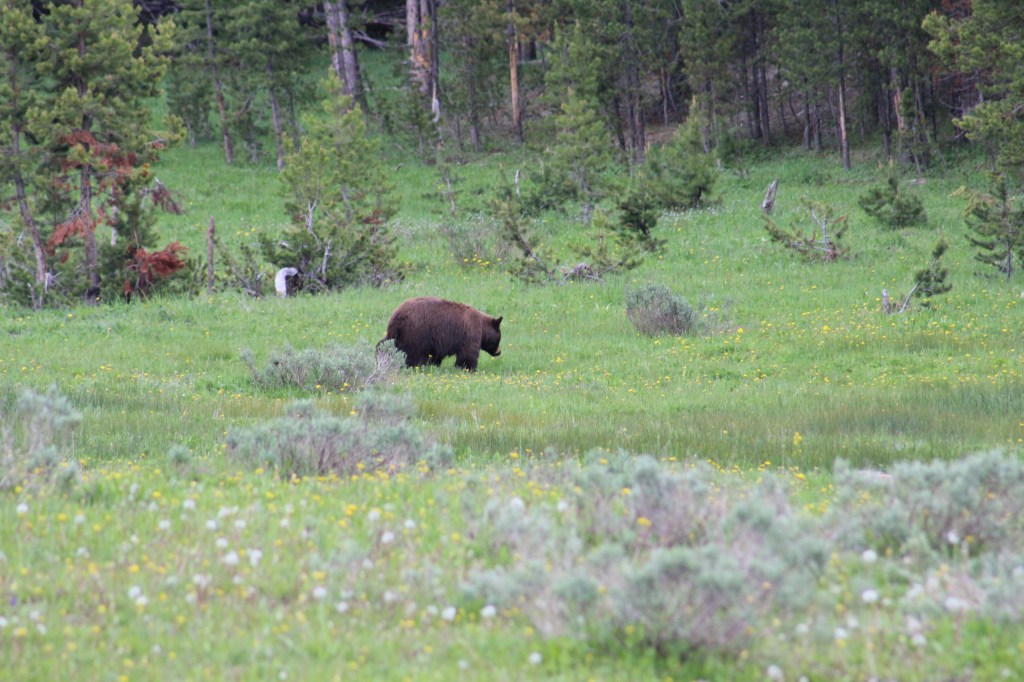
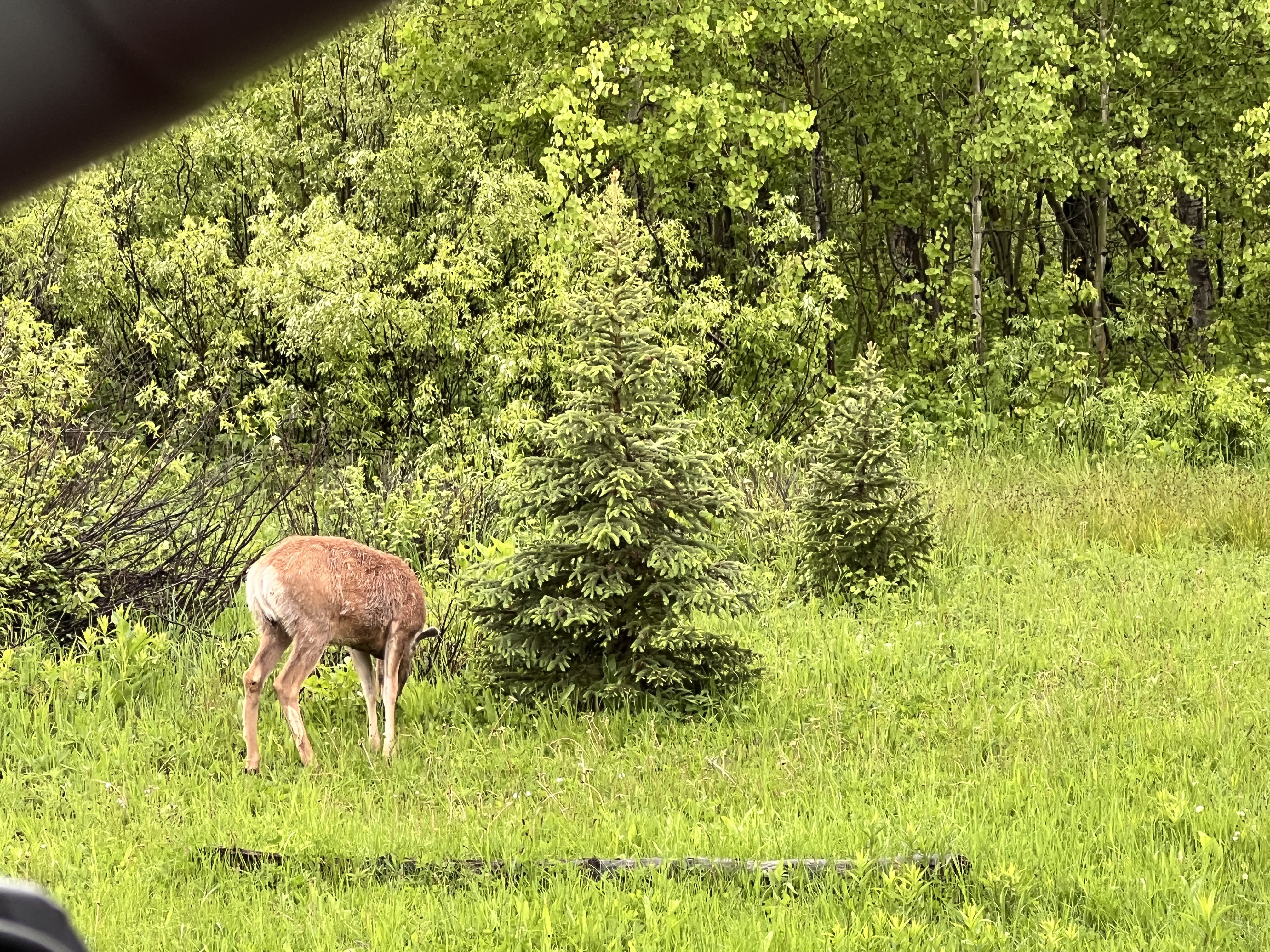

From Left to Right: Black Bears, White tailed deer and Bison with its calf
Go Hiking
If you are here that means you have enjoyed reading through this page and we have also made 1, 2 or 3 days itinerary depending on the amount of time needed at each attractions in the park and hope they make it more easier for you to plan your next travel.
There are plenty of places to hike in Yellowstone National Park and the park has more than 900 miles of hiking trails. Like it is famously said, you can spend an entire summer here and still wont be able to cover it.
Our top hiking trail picks are:
- Grand Prismatic Overlook
- Brink of the lower falls trail & Upper falls trail
- Upper Geyser Basin & Old Faithful Loop Area
- Artist Point Trail
- If you have time, you can do the entire Fairy Falls Trail which is about 4.8 miles out and back. (https://www.alltrails.com/trail/us/wyoming/fairy-falls–4)
- Mystic Falls Trail.
If you are looking for more trail options and if you have more time, you can visit NPS wesbite for more hiking trails: https://www.nps.gov/yell/planyourvisit/hiking.htm
1 Day Itinerary
Even though having one day is not sufficient, you can still plan your trip in a way to cover at least some of the top attractions in the park.
- Roosevelt Arch at the north entrance
- Mammoth Hot Springs
- Albright Visitor Center
- Tower Falls
- Lamar Valley
- Grand Canyon of the Yellowstone
- Upper and Lower falls
- Artist Point
- Hayden Valley
- Grand Prismatic Spring & Overlook (Do this in the afternoon)
- Old Faithful Inn & Geyer
- Yellowstone Lake (Do this before sunset)
- End your day by visiting Norris Geyser Area/West Thumb Geyser Basin
2 Days itinerary
Do all the above and also include:
- Artist PaintPoints
- Steamboat Geyser (This is one same path of Norris Geyser)
- Midway Geyser Basin
- Biscuit Basin & Black Sand Basin
- Lewis Falls & Moose Falls
3 Days Itinerary
For 3 days Itinerary, if you plan your day well, you can do all the top attractions we have in this guide.
That’s a wrap!! for this travel guide. Please do support us, write to us and let us know in the comments. We always welcome feedback and suggestions.
Coming Soon: Youtube video for Yellowstone National Park!!
 ARPostCardJourneys